Think Like an Animal: Without Words

Our use of language enables us to label ideas and think about them. A widely held belief is that animals have no language and therefore cannot think. But thoughts need not be based on human language. After all, how do people think who are completely deaf from birth and have never heard a spoken word? If you accept that thoughts can be based on a notion, image, intention, anticipation, insight or voiceless acknowledgement of a feeling, then you must believe that at least some animals can think.
How many kinds of thought are there? We are so used to human-style thinking that we may not realise our language-based system is not the only method of thinking. If animals do not have language and yet think, then they must think without words. They think in some kind of non-linguistic, non-verbal thought.
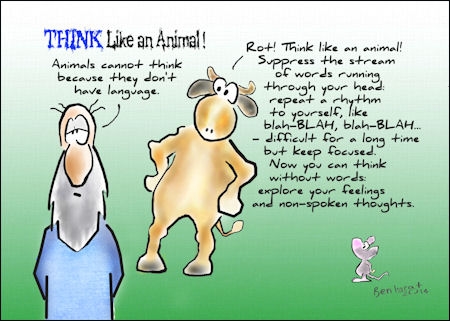
Can you think without words, without language? You can. Simply suppress your urge to think in words. Suppress the stream of words constantly running through your head by thinking over and over to yourself a short repeating rhythm, like "one, two, three". Or, if you are musically inclined, repeat to yourself two or three musical notes. You will find that, as long as you keep up your repetitions and do not let your mind stray, you can pay attention to and explore your non-verbal thoughts. Keep going for as long as you can. You may then be thinking more like an animal, say a cat, horse, whale or an elephant, than like a human.
Whereas your use of language enables you to excel at abstract thought, your non-verbal thoughts may incline you to a greater awareness of stimuli external to yourself, or how your body feels, or to visual images, emotions and notions of incipient activity. Think non-verbally of an everyday practical problem and then solve it by non-verbal reasoning or by insight.
We should credit animals for analysing problems and solving them mentally by their imagining courses of action and then carrying them out. A reason why animals are seldom credited for thinking is that few if any people master the art of thinking like an animal.
 ›› To Entries & Home