|
|
|

|
Chapter 5 Violence or Nonviolence
Snappy Page Essence
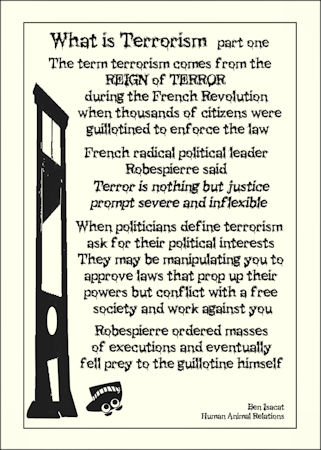
No one has succeeded in weighing the efficacy of violence versus nonviolence to the satisfaction of all. People argue as their opinions take them. Possibly the best overall course is to remain true to basic humane principles. "In moral terms, the granting of rights to animals leads to the conclusion that direct action in their defence is not only permissible but also a moral duty, although whether this justifies some of the more extreme actions involving violence is an open question." Robert Garner (1) Scope of AR Extremism Animal rights extremists have harassed their opponents, carried out arson attacks, planted and sent bombs and other devices through the post and issued death threats to individuals, animal laboratories, shops, factories, farms and other targets. Animal rights extremists caused £2.6 million ($4 million) of damage to property in 1,200 actions during the year 2000 and are the prime cause of violence in Britain since violence in Northern Ireland eased, according to BBC News (2). The police fear that sooner or later someone will be gravely injured. Many analysts maintain that the Animal Liberation Front (ALF) is an extremist group, an instigator and leader of animal rights violence. Set up in 1976 by Ronnie Lee, ALF claims it is not a violent organisation. But this may depend on what you call violent. Kinds of actions typically carried out by groups claiming inspiration from ALF are outlined in the entry Direct Action (Chapter 3). Analysts say ALF promotes 'leaderless resistance' groups, each group consisting of one or a handful of individuals, autonomous and completely detached from their instigating body, yet acting toward the same ultimate goal.
Another two extreme animal rights groups were the Animal Rights Militia, first active in the 1980's, and the Justice Department, created in 1993. Both groups claimed to be unrelated to the ALF, although many critics saw the same few people behind all three groups. The Animal Rights Militia claimed they were behind the grave robbing in 2004 of a woman involved with animal abuse; two years later three animal activists in their thirties were tried for the theft and sentenced from four to twelve years jail. The ALF has a branch in the United States, where they are a horror to the Federal Bureau of Investigation (FBI). The FBI classifies some political and economic opponents as 'terrorists' and lumps ALF members with them. Other US agencies classify terrorists only as political groups who cause people bodily injury or death, so are not concerned with ALF. Can We Justify Violence? A few people utterly reject reacting violently; even if seriously physically attacked they would rather die than fight back. However, most people would hit back with violence if sufficiently motivated. But whether you are for or against violence there is a good pragmatic question to ask about it. Is violence efficacious? Kinds of Violence First, a little digression. What sort of violence are we talking about? Violence is not possible to define definitively, but for the purpose of the following discussion let's make out four kinds of violence. These are imperfect definitions but they cover a lot of ground. They are (1) zero violence (nonviolence), (2) physical and mental violence to people, and (3) violence to property (property damage). 1. Zero Violence This is peaceful resistance by masses of people in the style of Mohandas Gandhi (1869 - 1948) and Martin Luther King Jr (1929 - 1968). Analysts of violence often quote these men as the prime exponents of nonviolence for Indian independence and black American civil rights, respectively. Gandhi's style of nonviolence is never violent under any circumstances, but is not necessarily always legal. For example, Gandhi incited people not to pay salt tax and he called for mass trespasses. The British imprisoned Gandhi several times for his intransigence. 2. Physical & mental violence to people Physical violence, like brute assault or murder, is rare in animal rights campaigning and not representative of the animal rights movement, although the news media make much of it given an opportunity. Harassment or torment, for instance by a noisy crowd screaming insults while picketing someone's home, is a mental torture for the occupant. Mental violence like this clearly overlaps with violence to property (below) in that you will likely suffer mental trauma if your home is burnt down in an arson attack. 3. Violence to property (property damage) Some people claim that you cannot be violent to property because property cannot feel pain. They call property damage sabotage, to set it off from violence. Eco-activists in the United States have called property damage ecotage or monkeywrenching. Destroying equipment, say at an animal laboratory or slaughterhouse (when no one is around to be injured) may be absorbed by insurance and therefore cause little personal bother to the owners. However, violence to property could conceivably end up as violence to people if care is not taken; someone trapped in a burning building might die or be injured or someone might be run over accidentally in a subsequent high speed car escape.
Views For & Against Violence Physical violence to people is pretty straight forward. As for the other kinds of violence, people voice assertions for and against them and their effect on powerholders (the people in society who hold power). The Table below is a summary that contrasts some important points of what people say for and against nonviolence and violence (mental violence and property damage).
Is Violence Efficacious? No one has been able to weigh the efficacy of nonviolence versus violence and come up with an ultimate conclusion that everyone can agree upon. The reckoning is too complicated. Instead, people argue for violence or nonviolence as their attitudes take them. The American philosopher Tom Regan outlines how we might hypothetically justify violence against people to save animals (3). In his opinion, you could use violence against people provided you have tried all nonviolent means first, that you have adequate time and conditions, that you are rescuing animals from extreme or mortal harm and that you do not use violence excessively. However, Regan thinks that in actuality we can never justify violence to people even when these conditions are met. Nonviolent methods, he says, are never sufficiently exhausted. He holds this view even though he acknowledges that animals are harmed and dying all the time and that the violence some animal rights activists do is like nothing compared with the huge harm people do to animals, often backed by the law and social respectability. Applying nonviolent methods, for Regan, is the only way to advance, even though they are laborious, strain our patience and the results are often ambiguous. What about the effectiveness of property damage and mental violence to people? Partly by using these means some animal rights activists in Britain have succeeded in closing down companies breeding cats and dogs for experimentation (Hillgrove Farm and Consort Kennels) and are on the road to closing down Huntingdon Life Sciences, a much bigger breeder. (See the Chapter 3 entry Direct Action, under Stop Huntingdon Animal Cruelty.) Such determined campaigns show that these methods can be effective, at least in the short-run. These methods contribute to save some animals and create publicity, public debate and new converts for animal rights. Property damage can also work on another level, for example, through apparently unjustifiable, pointless destruction or defacement of property - what people call vandalism. Karen Dawn, American writer and journalist, tracks controversial animal related stories in the news media (Chapter 4: Media Watcher). Through her web site (DawnWatch.com) she alerts her subscribers to send rational, animal-supportive responses for publication to the news editors where the stories appear. In Dawn's opinion there is no unfavourable or adverse animal rights publicity. She says any publicity keeps the issue of animal rights alive and enables members of the public to send intelligent and enlightening comments to the press to influence the reading public for the better. Critics of violence, however, say that rescuing a few animals and closing down some animal-using companies are only fleeting victories. They say that what we need is to create lasting change and for that we must transform the views of the majority of people in society. For example, Bill Moyer (1933 - 2002) was an American activist who fought for civil rights and the environment for nearly 40 years. In his Practical Strategist (4) he summarises his discoveries about how successful nonviolent campaigns develop and describes a nonviolent method for activists to develop their strategies. Moyer's argument is that ultimate power lies with the people, not with the powerholders (in Moyer's case nuclear power companies and official state authorities and in our case politicians, animal experimenters, factory farmers and other upholders of animal exploitation). Powerholders, says Moyer, can only prevail as long as the majority of people believe the powerholders are working in the interests of society. Changes in the opinion of the majority of people, says Moyer, can force new conditions, such as fresh social policy and legislation that powerholders are forced to accept in order to retain power. Moyer says that activists must target the majority of people by nonviolent activities to "alert, educate, win over, inspire and involve" them through upholding society's values, traditions and sympathies; a social movement on the violent fringe will only alienate the majority of people and so be ineffective. Can Moyer's campaigning style really help in the case of animal rights? His outlook is based on mass nonviolent resistance. Bruce Friedrich, a vegan who has worked for animal rights in the US and specialised in 'confrontational' animal activism, voices an alternative opinion (5). Friedrich considers nonviolence in the manner of Gandhi and King (above) and warns that animal rights activists cannot follow their example. Gandhi and King, two giants of activism, could muster millions of people to march for their cause and rouse world public opinion behind them. But in contrast, says Friedrich, there are too few animal activists to hold massive demonstrations and world public opinion is presently not on their side. Consequently, Friedrich believes we have nothing much to learn from Gandhi and King nonviolence. Friedrich's models for action are the underground slave railroad in America and the resistance to Nazism in Europe: small numbers of people using intrigue, deception and sabotage fought for the interests of others. Friedrich acts where he puts his mouth. In Washington DC he assaulted the visiting mayor of London by throwing water in the mayor's face (6). He did a year in jail for 'destroying government property' - battering a jet fighter with a hammer (6). And he was arrested by the British police for streaking Buckingham Palace with "go vegan" painted across his buttocks, just as President George W Bush was meeting the monarch (6, 7). Indeed, you could argue that the campaigns of Gandhi and King, along with other social change campaigns, are not strictly comparable with animal liberation. As animal liberation philosophers have stated, the objects for freedom are not humans but the liberation of species not our own. Campaigning for social change directly affecting humans has human self-interest at its heart, something that campaigning on behalf of other species lacks. Campaigning for animal liberation, philosophers point out, is therefore more difficult. Going back to Moyer, you could argue that it is not necessary to engage in extremism for animal rights. We could win over more people to animal rights by making rational arguments for rights and by showing evidence beyond a reasonable doubt that issues harming animals also harm human society. An exemplar is Ray Greek and co-workers who make a scientific case that animal experimentation harms humanity (8). Another example is the many activists who argue about the effects of factory farming on human society, such as chemicals in human food, contamination of water and the spread of disease to people. But an altogether different approach to sharpening our rational skills and appealing to reason to win over the public, is limiting as far as possible the mechanisms for harming animals. Harms must be countered with technology to make effective, inexpensive alternatives, like:
Conclusion Many actions must be won to win a war, whether world war, war on terrorism or war on animals. Each action is just a small part leading to overall victory. We cannot know which actions contribute significantly to the final victory so we have to fight them all. Therefore, until we know what kind of actions actually work, activists should contribute what they can, whether raucously demonstrating in the street or quietly philosophising in books. "We are all working toward the same goal and we should support one another - as long as basic humane principles are not violated." Bruce Friedrich (5) References (1) Garner, Robert. Animals, Politics and Morality. 1993:239. (2) BBC News. Animal Rights, Terror Tactics. 30 August 2000. www.news.bbc.co.uk. (Accessed online 1 July 07). (3) Regan, Tom. How to Justify Violence. In Best A & Nocella A J Jr (editors). Terrorists or Freedom Fighters? New York: Lantern Books. 2004. (4) Moyer, Bill. The Practical Strategist: movement action plan (MAP) strategic theories for evaluating, planning and conducting social movements. Social Movement Empowerment Project, San Francisco. 1990. (Accessed online 6 July 2007.) (5) Friedrich, Bruce. Strategic Nonviolence in Perspective. No Compromise: the militant, direct action newspaper of animal liberationists and their supporters. Issue 11. (Accessed online on 2 July 2007.) (6) News Releases. People for the Ethical Treatment of Animals. (Accessed online 4 July 2007.) (7) Telegraph.co.uk. 19 July 2001. (Accessed online 4 July 2007.) (8) Greek, Ray & Greek, Jean S. Sacred Cows and Golden Geese: the human cost of animal experiments. Continuum: New York; London. 2000. ›› To Entries & Home |
Free Illustrations
|
|||||||||||||||||||||||||||||||||||||||||||||||||||||||