How to Do Animal Rights - & Win the War on Animals


How to Do Animal Rights - & Win the War on Animals
Home


 Chapter Sections

 1. Undercover Investigator

 2. Video Activist

 3. Animal Friendly Traveller

 4. Preacher

 5. Animal Rescuer

 6. Investigative Reporter

 7. Media Watcher

 8. Philosopher

 9. Flyer

 10. Personal Activist

 11. Animal Lawyer

 12. Politician

 13. Prisoner Supporter

 14. Public & School Speaker

 15. Aerial Snooper

 16. Scientific Investigator

 17. Solo Information Worker

 18. Street Theatre Actor

 19. Teacher

 20. Voluntary Worker Abroad
 
How to Do Animal Rights - and Win the War on Animals


Chapter 4


Activities for Animal Rights


10. Personal Activist


Not everyone wants to lobby politicians for animal-friendly legislation or go campaign marching in the streets. So what can you do for animals as a personal activist? You can do many things and they come at different levels of convenience. If there is a secret for successful personal activism it is that you should do what you feel comfortable with and are good at doing.

Three Personal Self-Activisms

Here are four reasonable personal activisms that anyone can do.

1. Let's Stop - It!

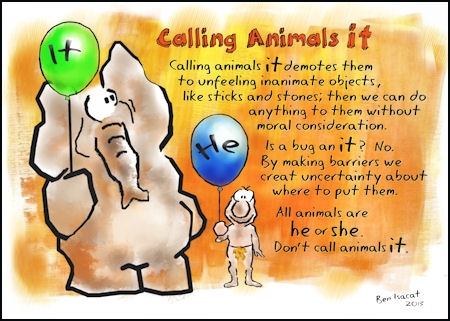
Most people call an animal an it, as if animals are unfeeling sticks or stones. They compound the offence by calling inanimate human creations, such as a car, ship or country, a she. So let's stop calling an animal an it. Make a contribution to animal rights by always calling animals him or her, he or she. You are conveying that animals are beings, with needs of their own. Calling an animal an it makes him an inanimate depersonalised object. As the philosopher Jeremy Bentham said, "animals...stand degraded into the class of things." (1)  Once a being is depersonalised down to the level of an it, we feel we can do anything we like to him without thought about his moral rights. Kicking a stone or throwing away a stick has no moral consequences (see Chapter 2: Animal Ethics).

But where do we draw the line? Should we stop at invertebrates? There is no logical reason to draw the line anywhere in the animal kingdom in that invertebrates are also males and females. Of course, some animals, like the workers of social ants and wasps, are sterile and some animals are hermaphrodites, like slugs and snails. But you can still call them him or her generally speaking.

What do you do if you do not know the sex of an animal? The rule in the English language is to assume the masculine until proven otherwise. Feminists will probably object to this rule and might demand political correctness instead. They may try to give equal weight to both sexes by saying "he or she". But this is clumsy. However, the Finnish language solves this awkwardness with a neat han. Han in Finnish means he and also means she: one word for both genders. Let's extend this idea. If we adopt han in English than we could go one step further to make han additionally mean it. Thus, han in English would mean he, she or it and would:
  • Avoid belittling animals by calling them it.

  • Avoid saying only "he" when you mean both genders.

  • Avoid unwieldy repetition of "he or she" all the time.
Examples of han:
  • Han sat down to tea with scones.

  • Han is a thoughtful and independent cat.

  • The whale yawned, rolled over then han swam away.

  • I gave a banana to a monkey and han ate it.
Political analysts have wondered if the equivalence of the sexes in Finnish has some connection with Finnish women getting the right to vote long before other women in Europe. So if we stop calling animals it, might we not start treating them better too? Another two other good Finnish words are hanet meaning him or her and hanen meaning his or hers.

If we adopted all these words in English:
  • Han would mean he or she or it.

  • Hanet would mean him or her or it.

  • Hanen would mean his or hers or its.
Alternatively, if these Finnish words are too much to accept into English, we could recast the English he, him and his respectively as het, hit and hits (that is, combine them with it or its). The big question is how to make these words catch on permanently.

2. Let's Speak Plainly

Should we be lulled and sweetened by euphemisms when faced with decisions about what to do with animals who get in people's way? Or should we speak openly and honestly about what is happening and not hide behind word substitutions to cover up what we or anyone are doing? People adopt euphemisms because they sound impartial, necessary, professional and reasonable, so that consciences are saved and nobody objects to the action. This table shows some frequently occurring euphemisms.


Table: A Selection of Frequent Animal-Related Euphemisms

Euphemism Plain English Comment
Meat Animal Strictly speaking, meat is muscle. This does not stop supermarkets selling products which they describe as 'meat' but can be from any part of an animal, such as lungs and brains.
Veal Calf - -
Venison Deer - -
Infested Has some Beaches may be 'shark infested' but they are never 'human infested'.
Road kill Motorist kill Roads do not kill anyone. It is the motorists who kill.
Harvest,
Cull or
Control
Kill People do not kill wild animals; they 'harvest' their populations, 'cull' and 'control' them.
     

Cull is often employed as a euphemism when dealing with wild animals. It really means to select and remove some things from other things, especially because of their inferior quality. But it is almost always used as a polite word whose action is somehow necessary and officially sanctioned. So we get:

"...the Deer Commission for Scotland flew in a squad of marksmen by helicopter to carry out the cull of 80 deer on the famous Badenoch estate..." Strathspey and Badenoch Herald.

"A cull of 5,000 hedgehogs is due to begin on North Uist in the Western Isles of Scotland on Monday. Scottish Natural Heritage wants to get rid of all the hedgehogs on the Uist islands because they have been destroying colonies of wading birds." BBC News.

3. The Cute Factor & Invertebrate Harmony

The cute factor refers to supporting some animals, such as fluffy animals with big dark eyes, because they are more attractive than other animals. The opposite side of the coin is ignoring some animals like rats, snakes and spiders, because they seem nasty and repulsive. Many people would be outraged by a slaughter of baby seals but are silent about a 'cull' of rats. Yet rats are as intelligent and as social as seals and moreover deserve equal consideration. People blame rats for spreading disease; but in the first place it is poor human living conditions with unsanitary habits that create the circumstances for rats to multiply and spread disease among people.

Let's learn to love all animals, try to live in harmony with all creatures and treat them with respect and compassion. So let's practice animal rights at the lowest level, that of the invertebrate: insects, spiders and other animals without a backbone. They make up over 99 percent of animals on Earth, are vital to the well being of the biosphere, and we can learn to appreciate them and the many wonderful things they do.

People often commit the number fallacy: because there are lots of them it does not matter if we kill them. But neither number nor body size determine the value of life. Invertebrates are small, but if we are aware of them and practice invertebrate harmony even on a small scale, then we will be more compassionate beings.

Here are some things you can do.
  • Instead of squashing invertebrates to get rid of them, pick them up carefully and gently and release them outdoors in a place that is suitable for them.

  • It is said that no one is ever more than a metre from a spider. There is at least one spider next to you now without you knowing it. However, the odd spider will not harm you and if you get rid of one, another will soon take his place (a house is like a cave, their natural habitat). So unless they are causing a real nuisance leave them where they are.

  • Let ants trailing into your house have their way if they are not causing you hardship. They are not harmful, will clean your house of debris and will soon be gone when the weather cools.
4. Let's Be Vegan or Veggie

Humans eat vast numbers of animals. In the United States alone every week people slaughter 175 million poultry, 2 million pigs, 700,000 cattle, 60,000 sheep, plus a host of other animals (2). But vegetarians and vegans opt out of the killing system. If you become a vegan or vegetarian you might save a pig or two annually, at least theoretically.

That animals have rights is the most basic reason people have for giving up eating animals. Specifically, animals have the right to live their own lives and not have humans kill them for food. In a more practical vein, vegetarians and vegans say their diet is healthier than a meat-based diet. Veggies and vegans like to claim they have lower blood pressure and fewer heart and bowel disorders than meat-eaters. People in the dietary business used to assert that your health would fail and you might die if you did not eat meat. But generations of healthy vegetarians and vegans are ample proof that they were wrong. Eating animals is dispensable and largely a matter of taste.

As a veggie or vegan you might help slow climate change - provided the veggie habit leads to farmers rearing fewer livestock. Methane is a potent greenhouse gas that traps more heat than carbon dioxide and the methane belched by the world's livestock is widely questioned as a factor contributing to global warming. It is generally claimed that 90 percent of New Zealand's greenhouse gas emissions come from the country's 40 million sheep (the human population is five million).

Vegetarianism is a personal commitment to animal life by setting an example to other people. If you are not already a vegetarian or vegan do not be put off joining them by thinking you have to give up eating all animals overnight. There are degrees of vegetarianism, like a freegan does not generally eat meat but might if other people discard it as waste and a flexitarian eats meat only rarely. Simply cutting back on meat-eating is a good start. Just eat a more extensive diet of everything else and more of it. Veganism is just a step removed from vegetarianism; just give up eggs and dairy products, phase out using leather, feather pillows and other animal products, and you are there!

More Active Activisms

Here are suggestions to get into the swing of more activisms for animal rights.

  • Read Labels
  • Ask the people who serve you where the ingredients of your food, cosmetics or medicine come from. Unless they are really knowledgeable they will probably not know any more than you, but patronise alternative products if any ingredients are derived from animals. Find up-to-date cruelty-free product guides on the Web to help you. Some ingredients to look out for are:
    • Musk: oil from the scent glands of certain wild animals, in particular the musk deer. The deer are killed in traps or confined all their lives to cages hardly bigger than themselves. Quite a lot of the musk in perfumes today is synthetic, however.
    • Rennet: a protein taken from the stomachs of slaughtered calves, lambs and kid goats. Rennet in the living young converts their ingested mothers' milk into solids for digestion. Rennet is the chief means for making cheese hard. Some hard cheeses are made with artificially cultured rennet and may be suitable for vegetarians.
    • Collagen: another protein taken from animals. It is used in cosmetics.
    • Gelatin (American English) or gelatine (British English) is derived from collagen and used in cosmetics and many foods.
    • Lactose: a sugar that comes from milk. It is added to various foods, lotions and medicines.
    • Cochineal: extracted from the ground up bodies of insects and used to add a red colour to foods and lipsticks.
  • Watch News
  • Speak up to defend animals when opportunities arise. Write to the news media when you think they are acting against the interests of animals. For background about this see Media Watcher, Chapter 4.

  • Spurn Animal Products
  • Avoid or at least cut down on using animal products, such as leather and feathers in pillows and duvets. Eschew fur items, not only fur clothing but also cosmetic and artists' fur brushes. These brushes are sometimes made from synthetic material but they are also made of animal hair. You can also find brushes with a mixture of synthetic material and fur. The labelling is often obscure and misleading.

  • Study Animal Ethics
  • Ask for animal ethics to be taught at your school, college or university. Animal ethics is a bona fide scholarly pursuit that incorporates animal rights but has broader scope (see Chapter 2: Animal Ethics.)

  • Dissection
  • Urge your school or college if they are into cutting up real animals instead to 'dissect' model animals virtually by computer program.

  • School Pets
  • Ask your school not to keep animals at the premises for educating the children/students.

  • Make Menus
  • You may be a veggie, but not everyone is, so ask for more animal-friendly (or at least less animal-unfriendly) food at your college or work refectory for the other diners. For instance, get management to ban eggs from caged hens and offer eggs from genuine free-range hens and generally to shun factory farmed animals. Persuade management to provide simple information about the food they offer so that diners know what they are eating and have a good choice of alternatives - free-range and organic.

  • Suggest Books to Buy
  • Suggest good animal ethical books (books on animal ethics, animal rights and animal welfare) that your public or college library can buy for their shelves. Ask your library to put up a display of these books.

  • Stimulate Ethical Policies
  • As far as you can, trade with companies that have publicly published ethical policies. For instance, use banks with a stated code of ethics. Pressure companies that have no ethical policies regarding animals to embrace a code of ethics incorporating animals. Become a (minor) share holder in animal abusing companies in order to criticise them more effectively as a share holder. Publicise their response or lack of one.

  • Stir Up Ethical Purchasing
  • Get your company to make its purchases from animal-friendly companies. If your company is not animal-friendly, ask them why they are not - with the intention of putting animal-friendly ideas into their head. Has your company a code of animal ethics spelling out how the company should act regarding animals and animal products? Get management or colleagues to compose one.

  • Act for the Little Animals on Your Doorstep
  • The common goldfish brings this home to us that animal rights is not just for big animals. Every year endless goldfish and other ornamental fish are sold and countless die. Many people stick their fish in glass bowls. The bowls are symmetrical and interesting but cause their inhabitants serious problems:
    • The water becomes deadly because the fish release liquid and solid waste into it.

    • The bowl has a small surface area, so not enough oxygen dissolves into it from the atmosphere for the fish to breath.

    • Left close to sunlight the water gets too warm and what little oxygen in it defuses out.

    • The fish cannot conceal themselves from staring eyes outside the bowl or shelter from each other within it.

    • The fish cannot satisfy their natural instinct to search for food or swim into crevices and explore; monotony extends for them 360 degrees all around.

    • Artificial life-support systems in bowls are weak, difficult to maintain and are no substitute for a better home than a bowl.
    Goldfish cannot shout and wave placards telling their people what they want. So it is up to us to point out to our fish-keeping neighbours the demerits of bowling fish. Point out to them how they can keep their fish happy, that fish do best in a roomy tank or, if they are outdoor fish, in a well positioned garden pond with lots of vegetation for aeration and cover.

    And what about birds in cages and animals in tiny garden hutches...?

    References

    (1) Bentham, Jeremy. An Introduction to the Principles of Morals and Legislation. 1789:xvii:311.

    (2) Statistics of Cattle, Hogs and Sheep and Poultry Slaughter. Annual Summaries. National Agricultural Statistics Service, United States Department of Agriculture.


    How to Do Animal Rights - and Win the War on Animals.

    © Roger (Ben) Panaman, April 2008. All rights reserved.