|
|
|

|
Chapter 7 Aristotle (384 - 322 BC)
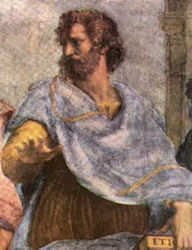
Snappy Page Essence Aristotle was one of the greatest thinkers of ancient Greece and his philosophy concerning animals is still highly influential.  Aristotle was one of the greatest thinkers, his thoughts spanning biology, physics, politics, music, logic, ethics, metaphysics and many other subjects. A philosopher who lived in ancient Greece, his views were widely held by Western philosophers and Christian and Muslim religions. His opinions are still very influential and with regard to animals on how we should treat them. Aristotle was one of the greatest thinkers, his thoughts spanning biology, physics, politics, music, logic, ethics, metaphysics and many other subjects. A philosopher who lived in ancient Greece, his views were widely held by Western philosophers and Christian and Muslim religions. His opinions are still very influential and with regard to animals on how we should treat them.Aristotle was born in Thrace, south-east Europe, and studied in Athens. As a teenager he was a pupil of Plato and then became a distinguished member of Plato's Academy. Later he opened his own school, the Lyceum, in Athens. The king of Macedon asked him to teach his son, who later became Alexander the Great, conqueror of peoples from Egypt to Persia and ruler of the largest empire of its day.
As well as philosophy, Aristotle immersed himself in politics, literary criticism and the natural sciences. He is the first person known to modern society to study nature impartially to understand how it works. Aristotle maintained that our only source of knowledge is from our sensory experience, as opposed, say, to intuition or revelation, and that we can discover the essence of all things by reasoning. Some of Aristotle's conceptions are that men are more rational thinkers than women and therefore are their superiors. Also that people with superior intellect should command weaker minded people, who should be their servants or slaves. Aristotle is attributed as saying, "Equals should be treated equally, and unequals unequally�(from his most well known work Nicomachean Ethics, vol 3). Apropos animals, he argued that animals are below humans because only humans can reason and therefore we can use animals without the consideration we would give to people. Aristotle's philosophy on animals is widespread in Western society today, partly because of the accomplishment of Aquinas incorporating Aristotle's thoughts into the Catholic Church: see Aquinas, Chapter 7. ›› To Entries & Home |
Free Illustrations
|