Vegetarianism

Everyone used to accept that eating animals was an essential part of a good diet. Experts claimed your health would fail and you might die if you did not eat meat. But generations of healthy vegetarians have shown that eating animals is dispensable. But why give up eating animals?

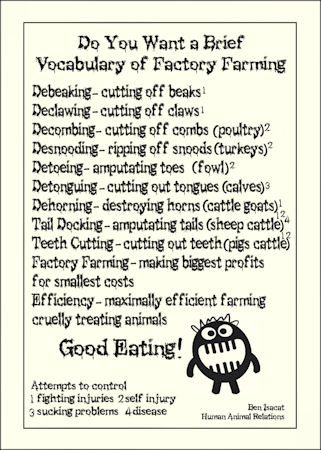
The way animals are raised at factory farms and the huge numbers of food animals transported and slaughtered make the food animal industry the single biggest cause of domesticated animal suffering nationally and worldwide. Most concerned people are powerless to influence the food animal industry, but by not eating animals they opt out of contributing to it. Vegetarianism is a personal commitment to animal life by self-restraint and by setting an example to other people.
"Our custom is all the support that the meat industry needs."
Peter Singer (1986): Applied Ethics: all animals are equal. p223.
The term
vegetarian was coined in 1847 at the inaugural meeting of the Vegetarian Society of the United Kingdom, the world's first vegetarian society.
Vegetarian is derived from the Latin
vegetus, meaning whole, sound, fresh, lively.
Click to go to silhouettes.
Numbers of Food Animals Killed
Billions of food animals are killed every year. For instance, the US annually slaughters two million pigs per week and China slaughters 12 million pigs per week (see Pigs / Hogs Statistics). Statistics show that the average amount of meat eaten per person per year worldwide has doubled from 21 kilograms in 1961 to 40 kilograms in 2002 (see Meat Statistics).
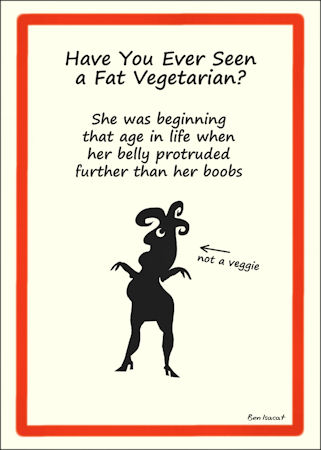
You Cannot be a Complete Veggie
No one can be 100 percent vegetarian. You swallow the cells that are continually sloughing off on the inside of your cheeks. You also emit a near invisible spray from your mouth when you speak. Some of the spray carries cheek cells and other debris. While dining and talking with people across the table some of their spray will land on your food. In the right light you can see this happen. Vegetarianism is about not eating animals. People are animals; so by eating yourself and other people you cannot be completely vegetarian. Vegetarianism is a matter of degree because we are all inadvertent cannibals!
Again, food crops are fertilised with the ground-up remains of millions of farm animals (for instance see Factory Farming and Fur Farming). So their molecular remains are incorporated into your grain and vegetables. Furthermore, there are just so many animal derivatives incorporated into medicines and used as food additives that we cannot always definitely know whether or not we are eating the products of animals. On the other hand, if you argue (narrowly) that vegetarianism is only about not eating actual meat (which strictly is the muscle of animals) then you might disagree with this.
Degrees of Vegetarianism
You do not have to abstain from eating meat totally to call yourself a veggie because people practice different styles of vegetarianism. Grades of vegetarianism depend on whether you eat dairy products, eggs, fish, or even small amounts of mammal or bird meat. Grades include:
- Vegans or strict vegetarians
- Do not eat animals or any animal products, like milk, cheese, yoghurt, eggs, lard, gelatine, rennet, cochineal, honey.
- Ovo-lacto vegetarians
- Do not eat meat but do eat dairy products and/or eggs. Ovo stands for egg and lacto for milk.
- Semi-vegetarians
- Do not eat so called red meat (that is mammals, for instance cattle, sheep, pigs), but eat poultry and seafood (fish, molluscs). Some semi-vegetarians may eat red meat but not from animals who are factory farmed or raised or obtained in some other inhumane manner.
- 'Freegans'
- Do not generally eat meat but may do so if other people discard it as waste.
- 'Flexitarians'
- Rarely eat meat.
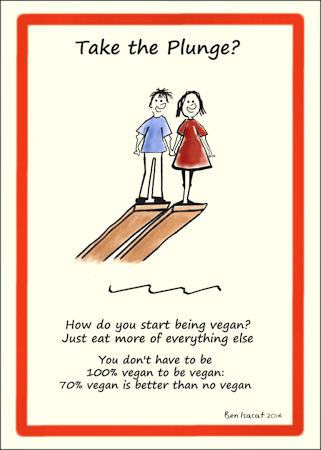
You may think these grades are cheats: either you eat animals or you do not. But you could argue that being even a partial vegetarian is a first step toward a greater commitment to animals and is better than no commitment. Even if you are a meat-eater you could contribute by getting your meat organic (fewer pesticides) and free-range (but the animals still go through the transport and slaughter process).
Numbers of Vegetarians
A difficulty estimating the number of vegetarians is agreeing on the definition of vegetarian (see the last section above). Even so, the number of people who are vegetarian is small nationally and globally. Various polls suggest that one to three per cent of people in the US are vegetarian and about four to six per cent are vegetarian in Britain. In both countries the number of vegetarians appears to be growing. However, the habit of meat-eating is increasing. As human populations grow in developing regions, like China and Africa, and people become affluent they eat more meat.
Why Be a Veggie?
People become vegetarian for a number of reasons, some of which are:
Animal Rights
You might agree that animals have moral rights - for instance the right to life, make their own choices, form normal social interactions with their kind, eat natural food and live in natural conditions - so that farming and killing animals to eat is a violation of animal rights and therefore morally wrong.
Suffering
People give up eating meat when they become aware of how food animals are treated, especially where rearing, transport and slaughter cause the animals to suffer.
Personal Health
Vegetarians claims they are healthier in certain ways than meat eaters, for example vegetarians have lower blood pressure and fewer heart and bowel disorders. Some vegetarians claim pathogens in meat or that chemicals ('additives') commonly added to meat can harm health. There is also a big illegal trade, largely unknown to the public, of slaughtering and processing animals in poor and unsanitary conditions whose meat is unsafe for human consumption.
Two good reasons for backing vegetarianism or for eating animals mindfully concern ecology and world poverty.
Ecology
Constant grazing of multitudes of cattle, sheep or goats prevents regeneration of the natural flora and its associated fauna. The topsoil erodes, making the land barren and the wild fauna and flora disappear. Forests in some countries are clear-felled for raising meat-animals and disappear along with the indigenous forest people.
World Poverty
Weight for weight the energy value of grain is several times greater than the energy value of the meat it produces if fed to food-animals. It is often said that a diet of grain could feed Earth's human population more efficiently than feeding the grain to animals in order to eat their meat.
Morality
If you concede that animals have interests, that like humans they want to survive and fulfil the full potential of their lives, then raising them for food and killing them would be morally wrong. To act morally right you would have to be a vegetarian or vegan, anything else is speciesism.
Some people argue in favour of eating meat because they say the strong (predatory animals) eat the weak (prey animals) and humans are the strongest so humans should eat meat. These same people also disparage animals as mere 'beasts'. But they cannot have it both ways. If humans are stronger than the beasts then we should exercise a moral choice and protect beasts as weaker beings, not exploit them. Incidentally, predators cannot decide to be vegetarians. They evolved to eat animals and would die out if they did not eat them. But humans can decide whether to eat animals or not. Humans will not die out if they do not eat animals. (Also see Predation).
Another argument entreating people to eat meat relies on the idea that humans have always eaten meat for thousands of years. However, just because something has a long tradition or seems natural does not necessarily make it morally right. Robbery and murder are also part of the natural, long-established stock of human behaviour, but this does not make them necessarily ethical (see Naturalistic Fallacy).
The worst excesses of factory farming, raising animals as inert products on an industrial assembly line and opposing the least shred of caring ethics, seem set to blunder on. Although more people appear to be giving up eating animals, there is no way that all humanity will embrace vegetarianism by choice. The only possibility for converting the masses is if a meat-making machine were invented: chuck in any old junk at one end and out of the other end streams food cheaper and indistinguishable from Jane Chicken and Joe Cow.
For & Against: argue your case
Rights vs Welfare
- Claim: Humans have rights. So animals who are also sentient should have a measure of rights too. The most basic animal right is to live and not be killed for food.
- Claim: Animals have interests and rights but people are more important. A moderate view is that humans are entitled to eat animals but that we have an obligation not to make animals suffer unnecessarily.
- Influence vs Morality
- Claim: Being a vegetarian will not influence the animal food industry because the industry is so big. Therefore it is pointless being a vegetarian.
- Claim: Any influence on the animal food industry by being a vegetarian is irrelevant. What matters is that if something is immoral, you should not do it. Eating animals is immoral, so you should not eat meat.
- Evolution vs Choice
- Claim: We have evolved to eat meat, like wolves and tigers, so humans should eat meat too.
- Claim: Animals species that evolved to eat a mainly meat diet cannot survive as vegetarians. Humans evolved to eat a wide range of food. As omnivores we eat fruit, grain and vegetables, as well as meat. So we can give up eating animals without harming ourselves.
- Extreme Places
- Claim: Eating meat is necessary because in some regions of the world crop yields are too low for people to survive. The Lapps in the Arctic eat mainly reindeer (caribou) because crops will not grow in such a cold climate. Therefore, some people have no choice but to eat meat.
- Claim: An atypical case like this does not support eating meat in places where wholesome alternatives exist, as in most parts of the world where people live. The vast majority of humanity, unlike the Lapps, can choose whether or not to eat animals.
- Protein
- Claim: A vegetarian diet does not supply enough protein. Meat supplies more protein than vegetables, invaluable against malnutrition and starvation.
- Claim: We get too much protein from our western diet. We can get all our needs from a balanced vegetarian menu.
- Grain vs Meat
- Claim: Raising meat animals is wasteful because to raise them you have to convert several kilos of grain protein (feed for animals) to get one kilo of animal protein (meat).
- Claim: Meat animals can be raised on land, such as mountain pasture, that is too infertile to grow crops for humans to eat. In such places growing animals for meat can be worthwhile.
- Humane Slaughter
- Claim: Meat animals are not really harmed because they are slaughtered humanely.
- Claim: But the animals are still killed. In any case, transport to the abattoir and the slaughter are often inhumane.
- Wholism
- Claim: If animals have a moral right to life, then plants, as living creatures, also have a moral right to life. Vegetarians, by eating plants, deceive themselves that they are morally correct.
- Claim: Food animals are sentient; plants are not. Plants do not have minds. Vegetarianism is about not harming sentient creatures.
- Long Life
- Claim: Farm animals live longer lives than wild animals. So farming is good for them.
- Claim: Animals live very short lives on factory farms. From what ever farm they come from they all go to the slaughterhouse in the end.
-
›› To Entries & Home