Is Ought Fallacy

The is-ought fallacy says that facts have no bearing on value judgements. Facts are facts whereas value judgements are value judgements, and it is a fallacy to argue from one to the other. Many people fall for the �is-ought� fallacy in all sorts of arguments. Therefore we should take care when arguing about animal rights because it is easy to make an is-ought error.

'Is' statements are claims about what there is, a description of a fact. For instance, it is a fact that people kill 50 billion chickens every year. An 'ought' statement is a value judgement, a claim about what people should or ought to do. For example, humanity should stop killing billions of chickens every year. The consideration of facts (about what is) can guide our behaviour about what action we should take (about what we ought to do), but no fact can inevitably determine what we ought to do.
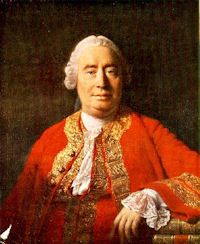
Philosophers give credit to the Scottish philosopher David Hume (1711 - 1776) for bringing this fallacy to light, often encapsulated in the saying: "you cannot derive
ought from
is".
 |
|
David Hume. He could not derive ought from is.
|
Three examples of trying to derive an �ought� from an �is�.
- 'Among all animals, humans excel at reasoning (fact); therefore humans ought to have special treatment (value judgement).' Simply by being good at reasoning does not mean humans should have preference over other animals.
- 'People have always eaten animals (fact); therefore, vegetarianism is wrong and you should eat meat (value judgement).' That our ancestors ate animals does not mean we cannot exercise a moral choice on whether or not we should eat animals.
- 'According to the theory of natural selection well adapted species survive and species not well adapted go extinct (fact); therefore we should not try to conserve species because only the best species will then survive (value judgement).' Although species go extinct it does not mean we should ignore their plight, especially if we are responsible for driving them to extinction in the first place.
›› To Entries & Home