Chapter 8

Climate Change
Climate change will wipe out millions of species and is the greatest burden on our moral behaviour because we, humanity, are responsible for it.
The Problem
The average temperature of Earth's air and sea is warming. This is called climate change or global warming. We can see climate change happening all around us, including melting Polar ice caps, dissolving permafrost, increasingly serious regional storms and changes in wild animal behaviour. Earth�s climate naturally changes slowly over thousands of years in response to changes in solar activity, Earth's orbit around the Sun, volcanic emissions, and other natural phenomena. But climate change is happening very fast, too rapidly for species to adapt to the changing conditions.
The Greenhouse Effect
Climate change is powered by the greenhouse effect. The land and sea absorb most of the Sun's heat reaching Earth. The heat then passes to the atmosphere and is lost to outerspace. However, some of the heat gets trapped by certain gases, so called greenhouse gases, in the atmosphere and remains next to Earth's surface.
One of the first people to recognise the greenhouse effect was Frenchman Jean-Baptiste Fourier in the 1820's. He coined the analogy with a greenhouse. The window panes of a greenhouse are like Earth's atmosphere, allowing the Sun's warmth in but prevent some warmth getting out, raising the temperature of the greenhouse.
The greenhouse effect is natural and without it Earth would be too cold for life to evolve the way it has. However, humanity has been releasing huge quantities of greenhouse gases and this has caused an unnatural, accelerating and fast warming of the climate. Currently humans release 22 billion tons of greenhouse gases into the atmosphere annually.
Cataclysms in the Offing
Climate change can trigger major cataclysmic events within the next 200 years.
- Greenland Ice Sheet Meltdown
- The ice sheet covering Greenland is Earth's second largest ice cap, containing about 10 percent of the world's fresh water. It is currently melting and can raise the sea level at least six metres (about 20 feet). The rising sea will engulf lowland coastal areas where countless creatures and billions of people live, including Shanghai, London, New York, Mumbai and Sidney. Millions of people and animals will be forced to move to higher land. Species that cannot migrate will go extinct as they drown.
- Gulf Stream Switch-off
- The Gulf Stream (also known as the Atlantic Conveyor) is a major current in the Atlantic between the Caribbean and Europe. It conveys 20 times more water than all the rivers on land. Within its body of water it carries heat and distributes it to the atmosphere across the globe. The Gulf Stream can shut off swiftly and permanently by ice cold water from the melting Arctic and Greenland Ice Sheet colliding with it. If this happens, north-west Europe would suddenly be thrust into an uninhabitable Arctic climate. A mass die off of most fauna and flora in Europe would be inevitable and millions of people would be forced to migrate south that would cause massive civil conflict and ensuing wildlife destruction. The climatic change would not be confined to Europe but impact on other parts of the world because all parts of Earth's climate are connected.
- Permafrost Melt
- Permafrost is ground a few inches below the surface that is normally constantly frozen solid, although the top few inches can thaw in summer. Permafrost occupies up to a fifth of Earth's land surface, circling the globe mostly in the far Northern Hemisphere. In some places it is around 1,000 m (3,000 feet) thick. The permafrost contains enormous amounts of carbon dioxide and methane. When the permafrost thaws it will release massive amounts of these gases into the atmosphere precipitously speeding up global warming with no control possible.
- Amazon Conflagration
- Climate change could dry up the Amazon rain forest turning it into one huge combustion holocaust. Since trees are made mostly of carbon, a burning Amazon will release vast amounts of carbon into the atmosphere suddenly driving up global warming. The majority of land species on Earth live in rain forests. When the Amazon is destroyed most terrestrial species will die with it.
- Ocean Death
- The surface of the sea absorbs carbon dioxide from the air above it. Increasing amounts of carbon dioxide in the air are turning the oceans into a dilute acid (carbon dioxide plus sea water makes carbonic acid, HCO3) and most marine life will perish - from microscopic plankton to coral reefs and whales. Marine death by acidification is already happening.
- Methane Hydrates Release
- Methane hydrates are vast quantities of frozen methane gas under the sea floor. There could be trillions of tonnes of it. Rising temperatures in the sea will trigger its release to surge up as methane gas into the atmosphere. Earth's warming climate will get an abrupt gigantic boost. When this happens, global warming will be out of all control and a mass extinction of life inevitable. Methane is several times more powerful as a global warming gas than carbon dioxide.
Biosphere Wipe-Out
How will global warming leave the Earth? The cumulative effect of all these cataclysmic events when they happen will be a climate change that destroys the biosphere, the realm of all living things between the atmosphere above and the lithosphere of rock below. Without the Arctic ice, creatures dependent on the ice will die off. As the jungles dry up most land species on Earth will vanish. The oceans and almost all life in them will be dead. Virtually all life on Earth will come to an end. Possibly the only life to survive might be micro-organisms already adapted to live in extreme environments.
Can We Stop Climate Change?
Once changes to large bodies, like the oceans and ice caps, are set in motion they take hundreds of years to slow down and stop. Nevertheless, some people hope to avoid the worst scenario: global warming accelerating so fast that it is impossible to slow. But can we slow global warming significantly? Politicians say we can reduce global warming without giving up our standard of living or aspiration for a higher standard. This is false because slowing global warming depends on:
- The amount of global warming fuel (oil, wood, etc) that humanity uses.
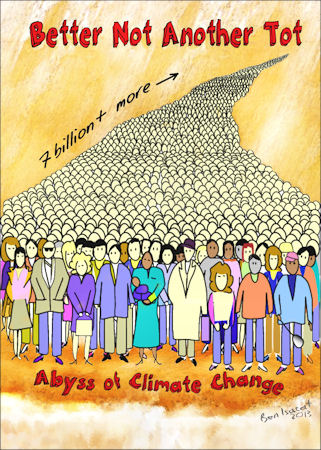
- The number of people on Earth and its rate of increase.
- New technology saving us.
- Enormously costly and widespread unpopular economic changes.
- But humanity continues to use fossil fuels and shows no sign of seriously limiting its usage. Humanity�s population is over seven billion and increasing without significant control. New technology is a reverie; it does not exist and probably could not be delivered in time if it were invented. And no one is going to give up resources unless the other guy/country does so first; people cannot divest themselves of their biological imperative to behave in their own short-term self-interests.
What you can do as an animal rights activist
You can try and help by joining organisations involved with climate change. At a personal level you can do two major things: do not make babies (more people more destruction) and give up your car (10 to 25 percent of carbon emissions come from motor vehicles). Set a good example to others.

The Main Greenhouse Gases
Here is a round-up of the most important gases that contribute to global warming.
Earth's atmosphere is almost entirely:
- Nitrogen - 78 percent
- Oxygen - 21 percent
- Some gases other than nitrogen and oxygen in Earth's atmosphere trap heat from the Sun and are called greenhouse gases. Some occur naturally in varying amounts and others are man-made. The gases include:
- Water vapour - less than 4.0 percent
- Carbon dioxide - less than 0.035 percent
- Methane - less than 0.0002 percent
- Nitrogen oxide - minute quantity
- Once in the atmosphere greenhouse gases remain there from about ten years to thousands of years, depending on the gas.
Water vapour
- This is water in its state as a gas. It is normally invisible but you can feel it as humidity in the air and see it as clouds in the sky and steam from your boiling kettle and hot bath.
- It is the most effective gas for retaining the Sun's warmth (holding about 60 percent of Earth's natural greenhouse gas warming). You can feel the warmth noticeably when comparing cloudy versus clear nights; clouds trap the Sun's heat.
- Its chemical formula is H2O, that is two atoms of hydrogen and one atom of oxygen.
- Carbon dioxide
- A colourless, odourless gas.
- There is relatively little carbon dioxide in the atmosphere (0.035 percent) but it is the most important greenhouse gas after water vapour and the most important man-made greenhouse gas.
- Human activities have released more carbon dioxide into the atmosphere than any other gas and it contributes most to man-made global warming.
- About 80 percent of the carbon dioxide people add to the atmosphere currently comes from burning fossil fuel (coal, oil and gas). Most of the rest comes from land use, such as clearing forests, agriculture and ranching.
- Because of the importance of carbon dioxide climate scientists take it as the standard for comparing the global warming potential of gases with each other. Carbon dioxide is set as one unit.
- The time taken for an amount of carbon dioxide to disappear from the atmosphere is 200 - 450 years.
- Plants are built largely from carbon. Plants remove carbon dioxide from the atmosphere to build their bodies from it. Fossil fuels (coal, oil and gas) were originally mainly plants, which is why burning fossil fuel releases large amounts of carbon dioxide into the air. Conversely, by growing plants (for instance forests) you can temporarily remove carbon dioxide from the air.
- Animals get their carbon by eating plants and incorporating plant carbon into their bodies. When animals and plants decay or burn, their carbon combines with oxygen and is released into the air as carbon dioxide.
- Its chemical formula is CO2, that is one atom of carbon and two atoms of oxygen.
- Methane
- A colourless and odourless gas.
- Its atmospheric concentration has more than doubled since the industrial revolution (that is post 1750).
- It has about 20 times the global warming power of carbon dioxide.
- Time taken for an amount to disappear from the atmosphere is about 12 years.
- Numerous human activities produce methane, for instance it is produced at coal mines, gas and oil wells and it evolves from decomposing garbage landfills.
- Like carbon dioxide, it is a natural by-product of the decomposition of once living creatures. Animals also produce it in their guts and farting cattle (1.3 billion worldwide) have been seriously questioned as a factor contributing to global warming. It is claimed that 90 percent of New Zealand's greenhouse gas emissions comes from it's 40 million sheep.
- Its chemical formula is CH4 (one atom of carbon and four atoms of hydrogen).
- Nitrous oxide
- Produced by natural processes and human activity, for instance agriculture (released by fertilisers), industry and fossil fuel burning.
- There is little in the atmosphere but it lasts 100 times longer than carbon dioxide and its global warming potential is hundreds of times greater.
- It is the same as 'laughing gas', administered by dentists as an analgesic.
- Its chemical formula is N2O (two atoms of nitrogen and one atom of oxygen).
- Other Gases
Some gases in the atmosphere are entirely man-made, generated by industry. Although they exist in the atmosphere in minute quantities they are nevertheless powerful greenhouse gases contributing to global warming with lifetimes from a few years to tens of thousands of years. Among these greenhouse gases are the halocarbons: groups of gases containing chlorine and fluorine, like chlorofluorocarbons (CFC's) and hydrochlorofluorocarbons (HCFC's).
Links to Web Sites About Global Warming
Pew Center on Global Climate Change
Europa: climate change
United Nations Framework Convention on Climate Change

›› To Entries & Home