|
|
|

|
Painism
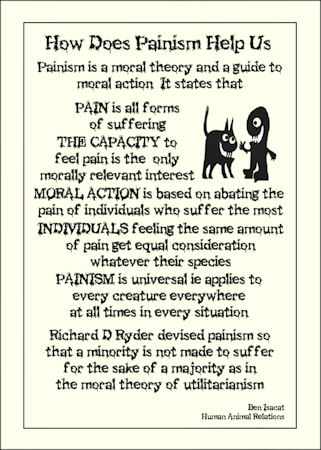
 Painism is a moral theory that helps you assess whether an action that causes pain is morally right or wrong. It helps you assess whether or not to carry out your action. Painism claims that the capacity to feel pain is the only morally relevant interest - not factors like the degree of consciousness, rationality or intelligence, as in a mouse compared with a dog, or a dog compared with a human - and that the right moral action should be based on abating the pain of individuals who suffer the most. Painism says:
Painism is a counter to utilitarianism. Utilitarianism is a moral theory that says an action is morally right if it benefits the greatest number of beings with the greatest good. According to utilitarianism you determine what is right by calculating the amount of pleasure or suffering your actions may cause and the right action will be the one that gives most pleasure or least suffering to the majority group. For example, some of your dinner guests are vegetarians and you wonder whether you should serve roast pig. As a strict utilitarian you poll your guests beforehand. Five guests say no to pig and twenty-five guests say yes. Therefore you serve pig and bring pleasure to the majority of guests - hard luck for the minority and the pig! As a rival to utilitarianism, painism says that the rightness of what you do does not depend on the number of individuals who gain from your action weighed against the number of individuals who lose by it. Adding up everyone's pain in one group and comparing it to the aggregate of pain in another group is meaningless. Each individual can only feel the pain in his own body; no one can feel the total pain of their group. Two units of pain in a body plus three unit of pain in another body cannot total five units of pain that anyone can feel. Unlike utilitarianism, painism does not permit a minority to suffer for the sake of the majority; the suffering of each individual is morally more important than the total number of sufferers. It is the severity of pain in an individual that is critical, not the quantity of pain unrealistically summed over many individuals. Painism, by making pain the basic moral issue and stressing the importance of individuals, leans towards philosophies that focus on individuals, such as animal rights and human rights. The British psychologist and ethicist Richard D Ryder (b1940) originated and champions painism (eg Painism: a modern morality. 2001). Ryder also coined the related term painient, meaning able to feel pain. A mouse, a dog and a human are painient but glass beads are not. Something painient can suffer and according to painism all painient creatures have rights. "The suffering of pain and distress has become the central issue in ethics today." Richard Ryder, Animal experimentation: good or bad. 2002:60.Some Criticisms of Painism How can we assess whether individuals are suffering the same amount of pain? We do not know exactly what pain other animals feel. Trying to compare pain in animals of different species, say a mouse and a chimpanzee, can be difficult or impossible. We can only make gross, subjective comparisons and people may disagree about the level of suffering they are witnessing. Basing moral actions only on subjective assessments of pain, therefore, may not be altogether sound. You might decide that inflicting pain on experimental animals could be morally wrong if it reduces only a little pain in other individuals. However, if the same action reduces a greater pain in other sufferers you might conclude that it is morally right to inflict the pain on the experimental animals. Painism, therefore, might protect some animals some of the time, but not all animals most of the time. It would be all right to raise countless animals to kill them for food so long as they did not suffer. Painism does not say much about the right of animals to life. If we can kill an animal quickly, without causing pain, then we might be tempted to do so, say for instance for sport shooting. Painism states that only painient creatures warrant moral standing. Therefore, according to painism, you would not give rights to intelligent aliens visiting Earth if they were advanced enough not to feel pain. Yet they would surely be deserving of moral standing and should be given rights, such as respect and freedom from intentional harm. It seems that painism can help us decide on moral issues, but at times we may need additional guidance beyond painism. ›› To Entries & Home |
Free Illustrations
|