Chapter 10

The Five Freedoms

The Five Freedoms were first proposed in Britain in the 1960's. The Farm Animal Welfare Council, established by the British government in the late 1970's to advise it on legislative and other changes for farm animals, subsequently affirmed them. The Council was conservatively made up of individuals with connections to agriculture: farmers, animal farming company directors, veterinary surgeons and academics specialising in agriculture. Other bodies concerned with animal welfare have approved the Freedoms.
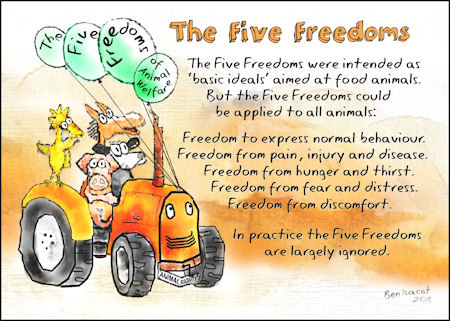
The Five Freedoms are:
- Freedom from Hunger and Thirst - by ready access to fresh water and a diet to maintain full health and vigour.
- Freedom from Discomfort - by providing an appropriate environment including shelter and a comfortable resting area.
- Freedom from Pain, Injury or Disease - by prevention or rapid diagnosis and treatment.
- Freedom to Express Normal Behaviour - by providing sufficient space, proper facilities and company of the animal's own kind.
- Freedom from Fear and Distress - by ensuring conditions and treatment which avoid mental suffering.
-
The Farm Animal Welfare Council say the Five Freedoms are a framework for viewing and improving animal welfare "within the proper constraints of an effective livestock industry." The Council stress that well trained and supervised stockmanship is the key to farm animal welfare: "...without competent, diligent stockmanship the welfare of animals cannot be adequately safeguarded."
However, the Five Freedoms are not inevitably applied and are more honoured in the breach. How much animal farming and stockmanship concede towards applying the Five Freedoms to animals is demonstrated by the realities of factory farming, such as the chicken and egg industry; nor are the Five Freedoms widely applied to animals farmed for their fur.
The Five Freedoms are basic ideals of welfare for farm animals, like livestock and poultry, wherever the animals may be, such as at farms, markets, slaughterhouses, or in transit, and should be applied by anyone in charge of the animals or handling them. The Freedoms make good common sense and are broad enough to apply to all farm animals anywhere in the world (indeed, to all animals, see Animal Friendly Traveller, Chapter 4).
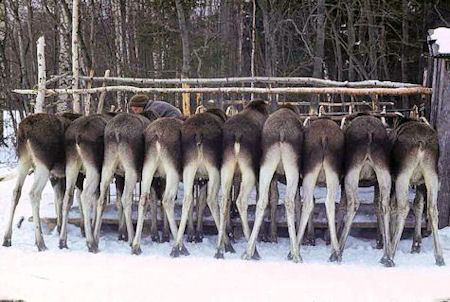
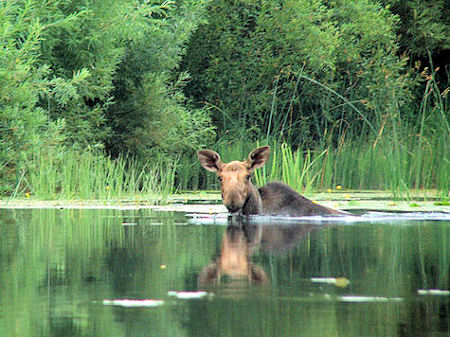
Young moose feeding at the Kostroma Moose Farm, Russia. The five freedoms apply to all sorts of farmed animals. Photo: Alexander Minaev.
|
Go to the Farm Animal Welfare Council for copies of their publications.
Also see Chickens and Broilers.
›› To Entries & Home