|
|
|

|
Chapter 4 Paramotor Flyer
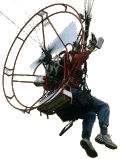
Snappy Page Essence Take up paramotoring for animal rights by looking down on your opponents to observe them and learn what they are up to. 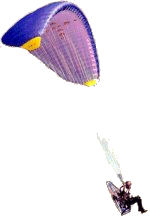 Look down on your opponents from a paramotor to observe them and learn what they are up to. Take videos of what they are doing and radio instructions to a ground team to close in on them. Your opponents could be shooters, trappers, rustlers, diggers for animals to bait, and anyone holding an illegal event in the open air. You do not need an aeroplane, quite an expense to buy and maintain. You just need a paramotor. A paramotor is the same as a paraglider but with an engine driving a propeller for ease of take-off and long-distance steering. It is the simplest and cheapest form of powered flight - a new paramotor costs about the same as a motorbike - and is easy to learn to fly. Although some bodies have classified paramotoring as a dangerous sport, it is said to be the safest way of flying, safer than riding a motorbike. Should your motor go dead, all that happens is that you glide and sink slowly to the ground, because your parachute is already fully deployed. The Paramotor A paramotor is a parachute, more technically a wing, attached to a harness with a little seat at the bottom bearing a small two-stroke motor. You lay out the wing behind you on the ground, strap the harness on to your back, start the motor and run a few steps. The wing inflates and gently carries you off the ground. Then you slip onto your seat and away you fly. Take-off distance is three to eight metres (10 to 25 feet) with a comparable landing distance. With experience you can even make a standing landing: land in zero feet. You do not need a runway for takeoff, just a big clear field (with a paraglider you would need a suitable hill for take-off). So if you live on the edge of town you need only carry your paramotor to a suitable field where you can launch yourself into the air. Otherwise, a paramotor is small enough to put in the back of a car and you can drive it somewhere else to get aloft. Once airborne you can fly to all points of the compass travelling at up to 40 kph (25 mph). You can fly on long cross-country powered-flights or turn the motor off and glide silently in thermals, restarting the motor in the air any time you like. Increasing the motor�s speed makes you climb, decreasing it makes you sink. You steer by pulling on special lines attached to the wing; pull on the left lines to go left, pull on the right lines to go right, pull on both sides to slow down. An alternative way of steering, for when you really need both hands free for filming, is to fit a tricycle undercarriage to the paramotor and press against its foot bars using your feet. You can buy a tricycle undercarriage from a small number of devotee paramotor-makers. A tandem paramotor may be more suitable than a solo paramotor if you need to concentrate entirely on flying, in which case you will take an observer/camera operator with you. Of course, a tandem is more expensive and less manoeuvrable than the solo craft. But then when flying your paramotor as an observation platform you want one that is stable and easy to handle, not one that is made for performing aerobatics. 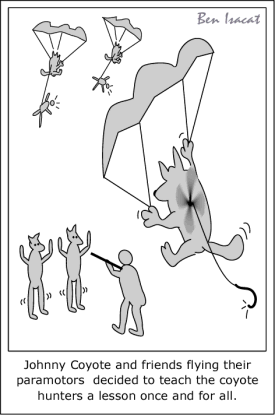 Learning to Fly a Paramotor Some paramotoring enthusiasts organise themselves into clubs and offer to teach novices the ways of the paramotor. They may give you a minimum of 25 hours coaching spread over several days and offer you the hire of one of their paramotors plus flying equipment. Their syllabus should cover groundwork and airwork. Groundwork is what you must know before taking to the air, including knowledge about equipment, motors, safety, flying theory, weather and air law. The airwork is what you need to know to get airborne, fly around and land. On successfully completing a course they may give you a certificate that might be validated by a national or international body. The cost of the course could work out as equivalent to the price of a new paramotor. However, paramotoring is a sport that so far has gone largely unregulated by the aviation authorities in most states, including the United States and Britain. Thus you will probably have no need for a licence to fly a paramotor and a certificate from a club may not be necessary. Indeed, there is nothing stopping you from learning to fly a paramotor without doing a course at all (but see What You Need, below). Another way to learn to fly a paramotor is by teaming up with an already experienced paramotor flyer. Or you could learn to fly a paramotor alone, like the early pioneers of flight; they had no one to instruct them. Whether or not you take a taught course or learn by yourself, in the end you still have to go solo - fly alone on your first flight - because no one else can fly the machine for you. There are a few dual machines about but they are not in much use. Should you opt to learn to fly a paramotor alone you must be confident you can do it. Do not be in such a rush to get off the ground that you make potentially disastrous errors. Perhaps the most common mishap you can make as a novice paramotor pilot is during launching. Inexperienced paramotor pilots running along the ground may try to get into their seat too soon, before the wing has time to lift them properly off the ground. They lose their balance and fall over, and there follows embarrassment and injured pride. The really unlucky ones get their propeller bent as it bites the dust. This is about the most serious practical blunder you can make when learning to fly a paramotor, even with instruction from a club. Read all you can about paramotoring, especially if you intend to master by yourself the art of how to fly a paramotor. Work through one of the syllabuses for learning to fly a paramotor. You can pick up a syllabus on the Web or get one from a club. There is a fair bit about paramotoring online, including video clips of paramotor pilots taking off, flying about and landing. Two good books are by Whittall (1) and Goin (2). What You Need What are the prerequisites for flying a paramotor?
 Advantages of a Paramotor
Bibliography (1) Whittall, Noel. Paramotoring From the Ground Up: a comprehensive guide. Airlife Publishing: England. 2001. (2) Goin, Jeff. Powered Paragliding Bible. Airhead Creations. 2006. ›› To Entries & Home |