| |
|
|
Chapter 4

Animal-friendly Traveller
 What�s the Problem?
Animal abusers earn money by displaying animals to travellers and tourists, especially in Asia, Africa and South America. The animals, often taken from the wild, are frequently poorly kept, neglected or over-worked. They eventually die or their owners kill them when they are past their usefulness. The final betrayal is selling their body parts as souvenirs. Untold numbers of animals suffer like this for the tourist trade and you could witness it anywhere in the world.
Many travellers would not tolerate similar cruelties in their own country. Nor should we accept as an excuse for cruelty the assumed sanctity of another country�s customs and culture. Each of us is responsible for ensuring as far as we can that our behaviour does not contribute to animal suffering, even when we are abroad. We can go native in foreign lands but must keep our compassion.
What You Can Do - the Five Freedoms
It is normal to wonder just when you should step in to try to prevent cruelty. Mistreatment may not be clearly apparent when you are just a temporary visitor to a country with strange customs. But we can bear in mind a minimum standard for animal welfare. Animals must have access to their proper food, to water and shelter, should look healthy generally and not have physical wounds or obviously be mistreated, such as whipped or punched.
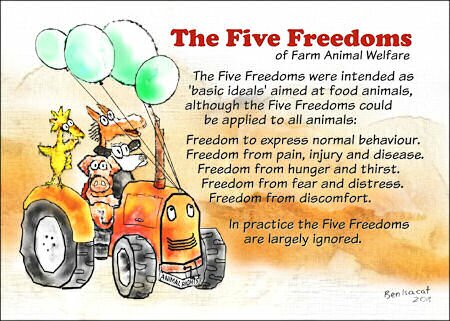
When judging whether to intervene you can apply The Five Freedoms as your standard criteria. The Five Freedoms are applicable worldwide but were first proposed in Britain in the 1960's and subsequently endorsed by the Farm Animal Welfare Council, set up by the British government to advise it (see Chapter 8: The Five Freedoms). The Five Freedoms are so basic and applicable to animals used in trade that they serve for any animal, not just farm animals.
The Five Freedoms are:
- Freedom from Hunger and Thirst
- Freedom from Discomfort
- Freedom from Pain, Injury or Disease
- Freedom to Express Normal Behaviour
- Freedom from Fear and Distress
Examples of Animal Attractions
Some schemes to look out for are these.
- Bear dancing: wild bear cubs are caught and trained to stand on their hind legs to dance and do tricks for onlookers.
- Animal photography: young animals like monkeys, chimpanzees and lion cubs, are made to let tourists fondle them while a photo is taken. Tourists are photographed standing next to large exotic animals, like an adult lions or bears.
- Traditional medicine: eg bears are kept in tiny cages and farmed for their bile sold as 'medicine' for ailments; tigers are killed for their penis for people in Asia to eat as an aphrodisiac.
- Cats and dogs: across Asia, cats are cooked and skinned alive; dogs are hung slowly by the neck to die, reputedly to make them taste better.
- Souvenirs and trinkets: these are made from animal body parts, like bones, ivory, shells and coral reefs; many come from species that are �protected� by law.
- Selling animals as pets: many pets are taken from the wild all over the world and die during shipment by traders.
- Circuses and aquariums: for fish, sharks, turtles, dolphins, orcas and all sorts of animals, where their basic needs are not met.
- Roadside Zoos: animals are tethered or caged to attract customers to buy goods on display.
- So what can you do when you discover abuses like these? You prepare yourself before you travel, take action when you travel, and do some follow-up when you return home.
Before You Travel
You may be using tour operators. Ensure they do not encourage or advocate activities that exploit animals or that they deal with hotels which do. Tell them at the outset, preferably in writing, that you want animal-friendly services. Many operators may not be familiar with animal-friendly travel, so tell them what animal-friendly travel means: non-patronisation of animal cruelty - including being able to obtain vegetarian or vegan food. If an operator really cannot accommodate your wishes then think twice about using them.
Prepare before you go on your trip. Being prepared will make you feel more confident and take a lot of worry off your mind. Aim to get a good idea of what you could do should you encounter animal cruelty where you intend to travel. You can do much by searching the Web:
- Find out what animal mistreatment you might expect to come across. You can count on certain abuses in particular countries, such as serving tortured cats and dogs in restaurants in China and south-east Asia and bear dancing in India and the Balkans.
- List potential helpers in the region where you will be travelling, especially humane societies and bodies that enforce animal welfare.
- Try to find out animal friendly laws where you are going. You will then have a measure of control over abusers by quoting to them the law in their country as a stimulus for them to stop their abuse.
While You Travel
The simplest thing is to ensure as far as possible that you patronise only cruelty-free attractions. Avoid paying for entertainment, goods or food that you think may contravene humane behaviour to animals.

However, a stronger response is to object and complain about abuse. Take immediate action while travelling if you see animals being mistreated or you may lose the opportunity to help them. The least you can do is find who is in charge, outline your position and ask them to stop what they are doing. You have made a stand, however they react, and communicated to them that not all tourists approve of their activity.
A stronger step is also to complain to the local authorities. Legal protection is so varied that in some countries you may not easily be able to persuade the authorities to take action. But even in foreign countries you have a right to complain. Use your right for the animals you see abused. Remind the authorities that the money tourists spend is an important means of revenue for their country and that animal abuse turns tourists away and gives their country a bad name.
In serious cases, where you really have to get in touch with the authorities, collect as much evidence as you can for them. This would be best before you tackle the abusers themselves about their behaviour.
- Note the date and the place. Record how many animals are involved, whether young or old, and their species. Take photos or video and keep any freely available documents (like leaflets). Try to collect written and signed statements from other witnesses with their addresses. Finally, get the names of the abusers concerned.
- Lodge a complaint with the local police if you think anything is illegal. Inform local animal welfare organisations that may be able to help and request they send an officer immediately to check the situation. The testimony of an expert witness, such as a vet, can be invaluable.
- Tackle your hotel, tour operator and local tourist office if they have any involvement. Ask your local consulate or embassy for guidance on what can be done.
- Ask other witness of the abuse to follow your example; the more people who protest, the more seriously you will be taken. Give witnesses full details of who to contact.
Prompt and continuing action is crucial; the more you dawdle the greater the chance that all the evidence will fade and the authorities will do nothing. Try to keep the originals of any documents, but first make copies of them if you have to hand them over as evidence. Stay in the area as long as possible until the problem is in hand or return later. Keep a record of everyone you contact and decisions made.
Be persistent. If you are not satisfied by enforcement officers tell them you will speak to their superiors, and do so if need be. If the authority is reluctance to act and you still cannot get anywhere, try the local dignitaries, such as the local mayor and councillors. You may find that persuading people to act is easier if they know you have alerted the local news media about your story; officials want to keep their jobs and often do not want a bad press.
When You Return Home
If you could not contact local animal welfare organisations where you saw the abuse, write to them on your return home to say what happened and ask if there is anything they can do. Also give your tour operator the full story, even if they were only remotely implicated. Say that as an animal friendly traveller you can only support and recommend tour operators if they take positive action to recognise animal abuse and, if not suppress it, then at least not to patronise its perpetrators.
Don't feel that you are powerless to help animals on your travels. Being an animal friendly traveller you help local communities because in the long-run they will gain from a healthier respect for animals. A better life for animals will not come about overnight, but a continual flow of Western ideas about animal ethics and complaints from disaffected travellers will count.

›› To Entries & Home
|
|
Free Illustrations
|
|