| |
|
|
Chapter 4

Video Activist
"All that you need to become a true video activist is the necessary equipment, practice to develop your required skills, and, perhaps most importantly, inspiration." Thomas Harding (1)
The miniaturisation and affordability of video technology has brought to the streets and fields the video activist or 'videographer'. Images and sound-bites have the power to seize people's attention and bring home the reality of what is happening around them. Video activists wield the video camera to defend and promote civil rights. You can harness the power of the video camera to bear witness for animal rights. Freelance or work for animal voluntary organisations on their campaigns. Video the odd demonstration or work on a long-term project setting objectives and targeting specific audiences. Set yourself up as a lone video activist or gather a team together. When sufficiently experienced you could train others to be video activists too.
  Personal Qualities You Will Need
As a video activist you should or will have to:
- Learn the skills of taking and making a good video. You do not need to be a film producer or photo journalist to be successful.
- Not mind obtruding on people: asking them probing questions and poking your camera into their faces.
- Be confident and courageous when approaching rowdy or aggressive people in hectic situations where you might get hurt physically or when approaching despairing people in desperate conditions where you might get hurt emotionally.
- Feel comfortable with ears muffled by headphones, staring through your camera, separate, even alienated, from everyone around you when the action gets hot.
- Be able to stick to your role as video activist should an animal or anyone get beaten or trampled. You will miss getting those video shots if you dilute your task with distractions. You must let others do the aiding work.
- Be willing to cope with tedium and frustration. Your mere presence does not guarantee that interesting incidents will materialise and you will spend days in the field when nothing of note happens. You have to hang around a lot.
What to Video?
Two basic video activisms for animal rights videographers are recording campaign videos and recording witness videos.
- Campaign videos
- You document events and conditions where animals are mistreated, neglected or abused. Your aim is to raise people's awareness, educate and exhort people to act, and persuade people to donate money to fight abuse.
- Witness videos
- You record at animal rights demonstrations. Your purpose is to capture evidence of illegal or vicious activity by the opposition or police against activist demonstrators as evidence in court. Taking shots of demonstrations can also be an important part of making a campaign video.
The Campaign Video
You are going to tell a story through video. So where do you find stories? You can easily access some places, like circuses, rodeos and zoos. Factory farms are a bit more difficult and you will have to use your ingenuity to video them, and laboratories and research institutions may be guarded and alert (but see Chapter 4: Undercover Investigator, under the section Surveillance Systems).
Video activists are not in the league of making three-hour documentary films. Depending on your purpose, a five to ten minute video can be long enough, certainly for the Web or to screen at a debate. Your intention is not to bore your viewers but to carry across what you want to say and your video should be just long enough for that. It is said that one picture is worth a thousand words; certainly, one timely five minute video is worth a three hour film. Examples of campaign videos are:
- A Circus Video
- Circus Suffering, produced by the Captive Animals Protection Society (CAPS), is a video that juxtaposes circus animals a hundred years ago with circus animals today. The video carries the message that we have advanced tremendously in our understanding of wildlife yet 'wild' circus animals still live in shackles. The video was shot at circuses across Europe, features elephants, baboons, ponies, lions, bears and tigers, and captures, says CAPS, "the confinement, deprivation and violence in these animals' lives." A television presenter narrates the twelve minute video, which also has a five minute Web version.
- A Foie Gras Video
- The San Diego City Council was deciding on a proposed law in 2006 to ban the sale of foie gras. The California based Animal Protection and Rescue League presented the Council with a 15 minute video as testimony, made in association with two other animal rights bodies. The Council passed the ban almost unanimously.
- A Rescue Video
- Go out on an animal rescue (see the Animal Rescuer, Chapter 4). Video the rescue team posing together and show them setting out and arriving at their destination (you could include a shot of the location on a map). Get wide angle views of the target premises then close ups of team members getting inside. Show the condition of the place and the state the animals are in. Also show the animals post-rescue being cleaned up at your base and recovering with adoption volunteers. To go the whole way and get the full story of the open rescue, you may want to video yourselves being arrested and tried, people's reactions, even yourself in prison. Add narration, and music to match.
Camera work will be only one of your talents when making a campaign video. Planning the video is the most important skill and may take up to eighty percent of video production time and most of your energy. Professional film makers plan their films with storyboards, drawing sequences of pictures that will make up the complete movie. Storyboarding makes a video a lot easier to direct and edit. You could do it that way. Alternatively, you could sit down, close your eyes and concentrate hard on visualising what your video will be about, shot for shot, searching for potential problems and thinking through how you will overcome them. Then, having sorted that out, open your eyes, make a list of the shots and finally go out and shoot them.
The Witness Video
Record events at animal rights demonstrations and in particular catch problems involving the police and opposition against the demonstrators. By videoing at demonstrations:
- You prevent or restrain by your mere presence any over-reactions and excesses by the police acting heavily against demonstrators or being idle when they should be attentive and competent. Police are accountable and do not want to be caught out on video for the world to see.
- You forestall opposition violence when they see they are being videoed. But keep an eye open for anyone wanting to 'taking you out', hopefully a rare and avoidable occurrence!
- You have video footage on offer to lawyers as evidence in litigation disputes to acquit activists and bystanders of spurious or inflated police accusations.
- You are on hand to capture confrontational fracas to distribute to the news media for publicity in favour of animal rights.
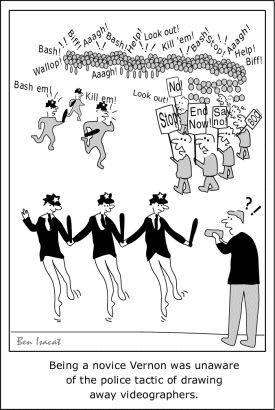
If the police think you are taking part in the demonstration, rather than being an uninvolved reporter, they might decide to arrest you on some trumped up charge, such as trespassing on private property or riotous behaviour. To counter this it may be prudent to shoot footage of both sides' altercations so that you can claim to be unbiased. You may also want something that identifies you as an impartial journalist or as a member of some part of the news media. Ideally you would flaunt an official press card. Failing that you could devise a business card ('Joe Snapitall - Freelance Photojournalist - Times Square.'), or have in your pocket a letter from a video company stating you are on assignment for them.
What you do not want to do is inadvertently record illegal activity that could get animal rights people into trouble. This might happen should your footage be shown publicly and wrongly interpreted or the police confiscate your camera and use your footage for their purposes. Do not think that the police will not seize your video camera, even if their taking it is illegal, as they can always make up an excuse afterwards.
While shooting your witness video speak a calm, objective, running commentary into the video camera's microphone. Start with the time, date and place and at appropriate moments re-state the time and position where you are shooting. Note the identity numbers of individual police antagonists, a description of anyone they arrest, and the name and contact data of witnesses. Follow up possible opportunities for more shots; find out where arrested or injured people were taken and check other video activists working close by to swap footage.
When the fur is really flying at a demonstration it is useful to have one or more helpers. They can assist you by looking out for good potential shots, protect you by watching your rear, and sneak your video footage out of the area if the police intend to grab it. Further, you might be more effective at demonstrations as part of a team of video activists, each member taking their own footage to make a more complete record of what is happening. Some team members could shoot close up, others from a distance, or take footage from opposite sides of an incident.
Interviewing demonstrators can be enjoyable and interesting. Ask open ended questions, like "what did you see?" or "what did you do?" Whenever they stop speaking just prompt them by repeating "then what happened?" Ask again if what they say is not clear; they must speak credibly. Elbow your way into someone else's witness interview; your job is to get evidence, not to be polite. Get phone numbers or addresses from good witnesses, but expect that they may not want to get involved.
Depending on circumstances you may want to shoot openly or from cover. People are sometimes shy, so you could act as though your camera is turned off and carry it inconspicuously while still shooting, or only use its microphone. A shoulder bag is handy for a lot of covert shooting. Cut a hole for the camera lens at one end of the bag and tape the camera in position making sure you can see the camera's viewfinder with the bag open. Cut another hole for your microphone or clip the mic to your clothes.
You may want to buy a pinhole video camera if your heart is set on covert work. These cameras sit on a dime yet zoom, tilt and pan like their bigger relatives. However, while the camera itself is not too expensive, you may have to buy a tiny recorder to store the images the camera takes and that could cost several times the camera's price tag. You will also need to buy other bits like cables, batteries and battery power adapters.
Basic Video Field Kit
Apart from access to a computer and editing software, you do not need much else for making videos than the basic field kit. The basic field kit of the modern video activist consists of:
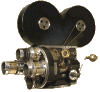
- Camera: often a camcorder (a camera with a built-in recording device) that plays back footage and sound.
- Batteries: probably come with the camera, but get a long-life battery as a spare.
- Battery charger: probably comes with the camera.
- Headphones: to monitor your sound recording. Buy them as an extra.
- Kit bag: for carrying your kit conveniently and safely. Buy this as an extra, too.
Video cameras are digital and video technology is a growing and fast-changing industry. Some video cameras record for several hours without needing attention, so you can keep recording without constantly downloading footage to a computer or changing batteries. Almost any brand of video camera (or camcorder) will do. But you may like it to have a good range of manual functions so that you can control it by hand depending on what you want it to do - instead of it choosing automatically and overriding you.
You may want to consider what the video camera will record its images and sound on. A video camera can record on a disk or hard drive. Small disks slot into the camcorder and you can record over them repeatedly. A hard drive is built into the camera (like a computer's hard drive), can accept several hours of recording and is easily transferable to your computer via a memory stick or other device.
12 Tips For Shooting Videos
- Start your video with an overall shot to show the context of your subject, such as a landmark, a signpost, a building, or something else relevant and unique to that place.
- Perch your video camera on a monopod or tripod to prevent it (and the footage) shaking. If you do not want a pod to impede you at a fast moving demonstration, brace yourself against something, like a lamppost or a helper's shoulder.
- Pan slowly and steadily from one scene or subject to another. Do not continually move the camera back the way it came. Your viewers will not want to be motion-sick.
- Get about ten seconds of footage on each of the important shots.
- Monitor what is going on while shooting by keeping both eyes open, one eye looking through the viewfinder and the other eye checking your surroundings.
- Learn to shoot while walking backwards.
- Check that you really are recording. You may have been recording when you thought you had stopped, and stopped recording when you thought you had started.
- Be discrete and unobtrusive. People may feel uncomfortable and object to you shooting. But sometimes it is worth making a nuisance of yourself for a good shot.
- Your video camera is also a tape recorder. It will record sounds closer to it better than sounds further away. Experiment with an external microphone. You can point it at sound sources and filter out peripheral noise.
- While recording, monitor the sound with headphones to make sure it is not a jumble of noise.
- Buy a cheap video camera if your equipment might get smashed, eg at a violent demo. But buy quality equipment if you intend your video for television or other public viewing.
- Prepare for Murphy's Law: if anything can go wrong it will go wrong.
Editing
You do not cut celluloid footage into strips anymore. Nowadays you do your video editing entirely on a computer. Nor is there any need for complicated editing software. Basic video-editing programs are installed on most new computers. Even elementary editing programs enable you to add titles, narration, music and special effects to a video. Choose the best footage and put the bits in order to make your video flow the way you want it. Get the editing right and you will have a lot of satisfaction from your completed video. Bear in mind that a witness video may best be left unedited if it is going to be used in court, otherwise it may appear biased and suspect.
Distributing Your Video
You are not a video activist by shutting your video away in the attic. You must show your work to influence people and therefore you must distribute it.
- Show your video online on your web site or blog, or upload it to a web site that displays people's videos, like YouTube.
- Describe your video to web site owners and ask them for a link from their web site to the page on your web site where viewers can see it. (Give a reciprocal link to the web site owners who link to your site.)
- Send out details of your video to potential customers, patrons and to anyone who might be interested in it. Briefly describe it (plus buying information) and include a web address where they can see a preview.
- Present your video at events arranged by animal activist organisations where audiences can view and discuss it.
- After much experience you may find that you are exceptionally good at video activism. Then you may be in the market to sell footage to television. Who knows, you might hit the jackpot by catching a sensational event that television companies fall over themselves to air!
References
(1) Harding, Thomas. The Video Activist Handbook. Pluto Press: London. 2001, xvi. 2nd edition.
Further Reading
Gregory, S; Caldwell, G; Avni, R; Harding, T & Gabriel, P. Video for Change: a guide for advocacy and activism. Pluto Press: London. 2005.

›› To Entries & Home
|
|
Free Illustrations
|
|