Chapter 4

Teacher
Snappy Page Essence
One of the most effective ways of opening minds about animal rights is teaching animal rights. Teaching methods are outlined here - and don't forget your students'
Code of Conduct to help you keep order!

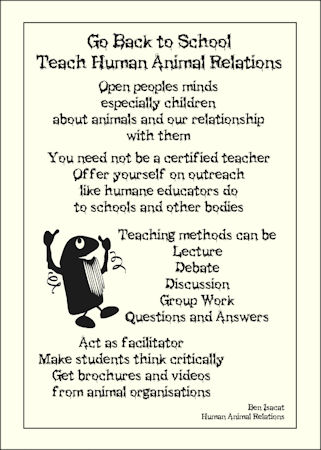
Teaching about animal rights is one of the most effective ways of opening minds to the nature of animals and of getting people to question how humans should treat animals. This is especially true when educating children. The field is new and open and you need not be a certified teacher to teach animal rights, although if you choose to teach through an establishment they might require some prerequisite.
Probably the closest thing to teaching animal rights is teaching humane education. Humane educators help their students understand that they have moral choices, that they can act for change and explore and develop a respect and compassion for humans, animals and nature. Most humane educators are voluntarily or part-timers. They offer presentations on outreach through their own initiative and/or through non-profit organisations to the wider community and anywhere people will listen to them. A few educators teach full-time at schools and teach humane education as an adjunct to their main work.
How to Start
So how do you start teaching animal rights? If you are already a teacher, sound out your school or college about teaching animal rights as a course in addition to your normal duties. Otherwise offer yourself on outreach in the manner of humane educators; explore their web sites and follow up leads they suggest. Also approach animal advocate organisations to offer your services in much the same way as a public speaker (see Chapter 4: Public & School Speaker).
Teaching Animal Rights
As an animal rights teacher you act as facilitator, point your students on their way and supply appropriate material and objective facts. You do not tell them what to think (see Criticism of Animal Rights Teaching, below) but get them to think critically, given their age group, about the issues you raise. You could encourage them to explore animal-human relations, examine the values held by society and held by them personally, question information from all sides in the animal rights debate and argue for and against alternative courses of action.
There are many questions you can set your students, such as:
- What are the harms for animals of humans using them?
- What right do humans have to use animals for human purposes?
- What is speciesism, who benefits from it and is it fair?
- How do we use language to obscure our use of animals?
- What moral arguments challenge the human use of animals?
- What are rights?
- What is natural and should animals have the right to live natural lives?
- Must animals suffer for human advancement and gain?
Test yourself by writing your own one or two page answer for each question!
Should you generalise across animal rights or specialise in a subset of animal rights? Being well-versed in animal rights generally will give you a solid background to build on and from which you can take off in any direction. Being a good all-rounder may be useful especially if you are peripatetic, because each school you visit may want you to adapt your teaching to the specific needs of its students. But on the other hand, you may prefer to teach adults a division of animal rights. For example, animal ethics is relevant to classes that study philosophy or religion; animal experimentation is relevant to classes into biological sciences; and vegetarianism is relevant to classes taking cookery and nutrition, as well to sociology by way of farming and world famine. Demand for your special subject might govern your options.
Criticism of Animal Rights Teaching
Some critics of animal rights say that animal rights activists feed children misinformation and that the children are �propagandized� (1). They claim that animal rights educators are confusing young minds by conflating animal rights with bona fide popular concerns for the environment and healthy eating, such as suggesting that vegetarian kids are more considerate and moral for nature than are meat-eating children. Furthermore, these critics assert that animal rights activists seduce teenagers with popular celebrities who verbalise vacuous emotional appeals for animals. These critics also maintain that animal rights educators are one-sided by not pointing out the usefulness of animals to humanity, as in biomedical research. So, beware; you will inevitably have some critics lambasting you as a slanted animal rights teacher, no matter how even-handed you try to teach!
Teaching Methods
You have several practical teaching methods to choose from, given the age of students and the time allotted for a presentation. Mix your methods if you like; one possibility is presenting a lecture and then a video followed by a debate.
- Lecture
- Address your students from the front of the class. This is the usual method for public speakers. It has little scope for input from the audience, although you could leave time for a question and answer session towards the end.
- Debate
- Divide the class into two groups. One group argues for a topic, such as the need for fur clothes or animal experiments, and the other group argues against it. Then a vote is taken and discussed by the whole class. Generates ideas and heated involvement.
- Discussion
- Get the whole class to discuss a topic. What would they gain by patronising zoos or what problems might they suffer being vegans and how could they overcome the problems? Encourages participation and communication skills.
- Group Work
- Divide the class into groups, each group developing and concentrating on its own theme, such as finding out about the international trade in animals or what aquariums do, which it then shares with the rest of the class for contribution. Allows students to participate and helps them think for themselves.
- Questions & Answers
- Ask students questions for them to ponder and answer. Encourages a two way student-teacher interaction and you can assess their state of knowledge. Useful at the end of a talk.
- Video
- Screen a video and use it in conjunction with some of the methods above. As a window to the outside world a video adds variety to your presentation that maintains the students' interest. Since people are visually oriented, your students may remember a video long after they forget your talk.
- Printed Matter
- Supply material that your students can keep and refer to after you leave them. Material may include fact sheets, information booklets and posters. Your students will be able to recall your talk better when referring to them and can pass leaflets and posters to their friends.
Dealing With Disruptive Students
Hopefully it will not always be so, but the subject of animal rights is controversial at present and can generate much emotion between opposing parties. Some older students and adults may have strong views to the point of being openly hostile and disruptive in class. How can you deal with them? Part of your teaching could include how to interact with respect and without hostility when disagreeing with others.
Julie Andrzejewski (2) is one of those rare teachers who have taught animal rights for several years (to students at St Cloud State University, Minnesota). She deals from the outset with potentially disruptive students by giving everyone in class her rules for her course and finds that her code soothes differences of opinion and forestalls hostility. Andrzejewski hands each student a sheet of the rules for referral in case of conflict down the line. A simple rendering of her rules for your students could go like this:
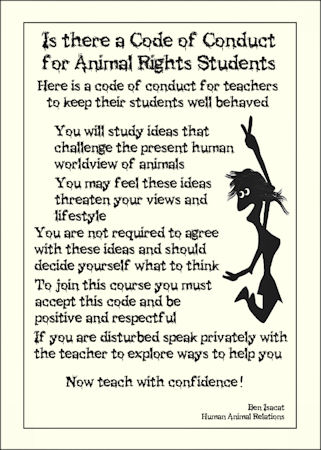
Code of Conduct
You will study material and ideas that challenge the present human world-view of animals and I will expose you to ideas and outlooks that you may feel threaten your views and lifestyle.
However, you are not required to believe what I say or present and must decide for yourself what you should think and do.
If you chose to remain in this course you must abide by this code and engage supportively, positively and respectfully in the classroom.
If you are upset in any way, speak privately with me to discuss practical steps to help you.
|
Material & Training
Various non-profit organisations offer material you may find invaluable. Some non-profits offer teachers free merchandise, including online lessons and activity sheets for teachers to print and copy, plus free videos and DVD's. Of course, not all animal rights videos are suitable for showing to children. Search the Web for suitable material for animal rights educators, such as AnimalAid.org.uk, ShareTheWorld.org.uk and TeachKind (at PETA.org/teachkind).
No courses presently exist where you can study animal rights full-time with the intention of teaching it yourself. This situation might change one day as the demand for knowledge about animal rights grows, so keep an eye open. However, a number of law schools in the United States offer the study of animal rights relating to the law (see Animal Lawyer, Chapter 4) and a few universities run short courses for undergraduates on the moral treatment of animals. You may also find some miscellaneous animal rights courses via the Web.
Also see Chapter 4: Public & School Speaker.
References
(1) Runkle, Deborah & Granger, Ellen. Animal Rights: teaching or deceiving kids. Science. 1997, 277:1419. (Accessed 8 August 2007.)
(2) Andrzejewski, Julie. Teaching Animal Rights at the University: philosophy and practice. (This paper has at least two different addresses on the web; one is at TeachKind.org. Accessed online 1 July 2007.)

›› To Entries & Home