|
|
|

|
Chapter 3 Direct Action
Snappy Page Essence Direct action fights for a cause dynamically and directly for immediate change, whereby adversaries must yield significant concessions, and rejects conventional slower methods of social change.  "In moral terms, the granting of rights to animals leads to the conclusion that direct action in their defence is not only permissible but also a moral duty, although whether this justifies some of the more extreme actions involving violence is an open question." Robert Garner (1)What is Direct Action? Direct action is activity that fights for a cause dynamically and directly for immediate change. You can view direct action as a strong form of civil disobedience with a capacity for acting illegally. Activists employing direct action aim to create a situation whereby their opponents have to yield significant concessions to the activists' cause. Direct action campaigners often tend to disown the methods of the less dramatic and slower mainstream who advance social change through education and legislative procedures. Among the issues in addition to animal rights in which direct action is employed are environmental protection, anti-globalisation, nuclear disarmament and asylum-seeker support. People have carried out direct action in labour disputes in Europe and North America since the 19th century and particularly in the 20th century by workers challenging government and big employers for social rights and political power. Strikes, boycotts, picketing, sit-ins, trespass and mass occupation of land or buildings, property damage and sabotage are some of the tools of direct action, with a measure of agitation, sometimes even violence by the more hot headed activists. But employers might also use direct action against activists, such as lockouts and mass dismissal of workers. You might say that governments use direct action in the form of mass fines, arrest and imprisonment. Examples of Animal Rights Direct Action Much direct action is perfectly legal and possibly the most successful direct actions are the legal ones, perhaps because they are sustained over a long period. Good examples of sustained direct action for animal rights are:
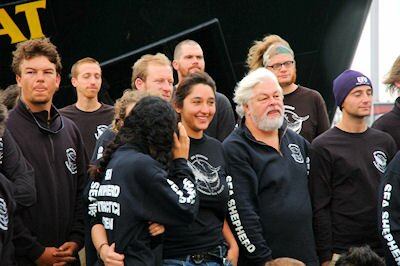
Without going into the ethics of illegal direct action, a criticism can be made about it. Unless an action is methodical and long-term against a particular target (such as with the intention of causing financial ruin and closure of a company), it may be seen by many people as wanton vandalism. It is debatable whether such actions have value for animal rights, although they might publicise the cause of animal rights and stimulate discussion. Individual Direct Action vs Mass Direct Action Sustained direct action needs a certain amount of organisation and long-term effort to be effective. However, you do not need to be a big group or a mass of citizenry to employ direct action (as in the three examples below: Sea Shepherd Conservation Society, the Battle of Brightlingsea, and Stop Huntingdon Animal Cruelty). One activist can be effective, as demonstrated by Henry Spira, albeit with some financial backing (see the chapter Personalities, under Henry Spira). Another example of direct action by an individual or small group of people is the Rambo affair. The pilot of an airliner at London airport in 2000 would not take off when one of the passengers refused to sit down. The passenger was a member of an activist group protesting the deportation of asylum-seekers from Britain. The pilot only took off when the activist and the object of the action, a deported asylum-seeker, together left the plane (2). The asylum-seeker was Salim Rambo, a 23-year-old political activist from the Democratic Republic of Congo (Zaire), who said he would be killed if he returned to his country of origin. According to later reports, Rambo was granted asylum in Britain. Sea Shepherd Conservation Society Sea Shepherd is a seafaring activist organisation based in the United States, operating three ships and a variety of boats. The society's name comes from its first ship, a trawler bought in Britain and renamed the Sea Shepherd. The society engages in direct action to save marine wildlife, especially whales, dolphins, seals and turtles. Its mission is to execute international maritime laws and agreements meant to protect sea species and the marine environment. A particular aim of Sea Shepherd, the one for which it is best known, is halting illegal whaling. Sea Shepherd's angle is not to protest against whaling as such but to fight illegal whaling operations. Flying a black Jolly Roger Sea Shepherd crews chase and obstruct whalers from illegally harpooning whales, they ram their adversaries' ships on the high seas and sink them in harbour. The organisation's small fleet of ships has battled with whalers from Spain, Iceland, Norway, Japan and other nations. The sea-going activists bring back film of illegal killing of whales to show on television around the world to increase public knowledge of marine issues and the carnage people do on sea animals. Sea Shepherd rests its legitimacy on its application of the law. Among the international treaties it invokes in the course of its work is the United Nations World Charter for Nature (1982). The Charter mandates individuals to enforce international conservation laws. In particular, under section 21 (c) and (e): States and, to the extent they are able, other public authorities, international organizations, individuals, groups and corporations shall: (c) Implement the applicable international legal provisions for the conservation of nature and the protection of the environment. (e) Safeguard and conserve nature in areas beyond national jurisdiction. And section 24: Each person has a duty to act in accordance with the provisions of the present Charter, acting individually, in association with others or through participation in the political process, each person shall strive to ensure that the objectives and requirements of the present Charter are met. Policing the seas and oceans of the world has its risks. While documenting illegal whaling off Siberia in Soviet territorial waters in 1981 a Sea Shepherd crew was pursued by an aggressive Soviet warship. And in 1994 a Norwegian Navy destroyer lobbed depth charges at another Sea Shepherd boat and rammed it.
Paul Watson, a Canadian and co-founder of Greenpeace, set up Sea Shepherd in 1977. Watson left Greenpeace to be more direct and confrontational in his actions. His radical property-destruction method of ramming and sinking illegal whalers shows that, always taking maximum care, you can sometimes use violent action without endangering human life. Watson is always mindful of the welfare of his and the whaling ships' crews. Sea Shepherd claim they have never caused or taken an injury. Watson and his colleagues have inflamed their opponents and been incarcerated and sued for crimes on the high seas. But all attempts to lock them up permanently have failed. Sea Shepherd justifies its actions by claiming that it always acts legally within the law. Sea Shepherd says that the ships it sinks are breaking international law by hunting endangered whales and as such are pirates. Sea Shepherd's critics claim the organisation harasses legal harvesting of the sea's resources and call Sea Shepherd crews pirates and eco-terrorists. Indeed, two of Sea Shepherd's ships have been struck off shipping registers, which means they can be boarded and captured as pirates and outlaws. On the up side, Sea Shepherd has saved the lives of many whales and publicised the plight of whales around the globe. Sea Shepherd says it is the "most aggressive and most successful whale-saving organisation in the world" and in 2000 Time Magazine named Watson an Environmental Hero of the 20th Century. The Battle of Brightlingsea Direct action was organised and planned in the example of Sea Shepard (above) and the example of Stop Huntingdon Animal Cruelty (below). But the Battle of Brightlingsea is a remarkable example of spontaneous action by ordinary residents of a small town. Brightlingsea, on Britain's North Sea coast, is hardly on the map, population less than 50,000. But in the early 1990's the anger of animal rights campaigners was growing at the apathy of politicians to ban live animal export (see the box, below). Campaigners were demonstrating at the points where animals were being exported, such as Coventry airport and seaports at Dover, King�s Lynn and Plymouth. Patience was running out. Brightlingsea was one of the exporting sea ports and became a flashpoint.
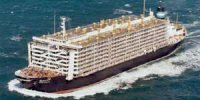
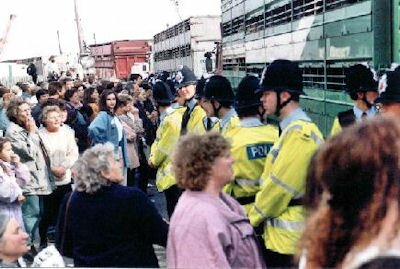
At Brightlingsea the transport trucks, loaded three tiers high with sheep, had to pass through the town's narrow streets to reach the port. Some local residents turned out spontaneously to stand in front of the trucks to impede them. The confrontation started in January 1995 and no one foresaw that it would develop into a battle lasting nine months. Residents of a town turning out for animals is an almost singular development in animal rights. Among the people were ordinary workers, housewives, school children and grannies, who had never been on a demonstration before.More transport trucks rolled through the town and more residents took to the streets to block them. The people innocently believed the police would turn the animal transports back. However, the transports were prepared and over a hundred police in riot gear arrived to escort them through the town. Protesters daily confronted the transport convoys from now on and the police always turned out in force to clear a way to the port. By February the animals were being transported to the port every day. The issue drew in protesters from much further afield. On some days up to 2,000 people lined the streets to heckle and shake their fists at the transport drivers.
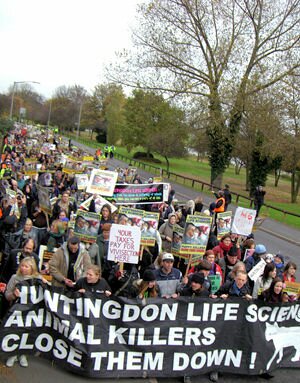
Protesters and police tried to avoid confrontation with each other but tension was always in the air as the police pushed the convoys forward to the port no matter what the obstruction. One night some protesters managed to drive a 60-seater bus to the gates of the port where they removed the wheels and handcuffed themselves to it. Some people voiced fears for safety as protesters pressed up against the transports in the narrow Brightlingsea streets. People threw themselves down in front of the trucks and held a sit-down in the road. The police forced back any protesters who tried to get in the way and warned them of arrest. People become casualties in the pushing and were tended by Red Cross medics on hand at the scene. The police arrested many people, even passers-by, and bundled them into vans to the police station at the nearest large town, where activists chanted and waved banners outside the building. During the Brightlingsea protests activists were carrying out actions at other ports around Britain. Transports were taking calves, destined for the European veal industry, to Coventry Airport and animal rights campaigner Jill Phipps (1964 - 1995) was crushed to death under a transport she tried to hinder (See the chapter Personalities, under Jill Phipps). The next day the Brightlingsea protesters held a candle-light vigil for her. The final convoy left Brightlingsea towards the end of October. In nine months 250,000 animals were exported through the town and 52 sheep died at the port. The Red Cross treated more than 100 protester casualties. The police made nearly 600 arrests and received a thousand complaints against them. The Brightlingsea protesters did not succeed in stopping a single one of the 150 or so convoys. But the cost of exporting the animals in the face of active protest was too expensive and ceased. The protesters had won. Veal calf exports from Coventry Airport, where Jill Phipps died, also soon closed down when the firm flying out the calves went bankrupt. Stop Huntingdon Animal Cruelty SHAC (Stop Huntingdon Animal Cruelty) is an ongoing campaign to close down Huntingdon Life Sciences, a company that carries out tests on animals, situated north of London, Britain, with an important branch in New Jersey, USA. Huntingdon is said to be Europe's largest animal testing laboratory and uses cats, dogs and primates, with the majority animals being rodents. Substances like pesticides, drugs and domestic and industrial chemicals are tested on the animals to assess their safety for human use. SHAC was set up in 1999 by seasoned British animal rights activists Greg Avery and Heather James after activists at the Huntingdon laboratory (secretly working for People for the Ethical Treatment of Animals) shot video of animals being abused. SHAC and its activities against Huntingdon have since spread to Europe and the United States. SHAC says it does not support violence of any kind. However, SHAC's methods are intimidation, harassment and property damage. Targets are Huntingdon itself plus the company's shareholders and business associates, including suppliers, insurers and bankers. SHAC also strikes out at Huntingdon's employees and their families. Thus SHAC targets a wide network of primary targets (Huntingdon), secondary targets (Huntingdon's business associates) and tertiary targets (families and investors). SHAC wants to show all of them that any kind of direct or indirect involvement in animal abuse is a bad investment. (For more about SHAC tactics see Chapter 5: The Law - United States and Britain.)
Because of the fear of attack by SHAC supporters, the results so far are that:
Comparing Direct Actions The examples of Sea Shepherd, the Battle of Brightlingsea and SHAC demonstrate that effective direct action can be organised (Sea Shepherd and SHAC) or spontaneous (Brightlingsea), with legal standing (Sea Shepherd), mainly law abiding (Brightlingsea), or pressing against the law (Brightlingsea) and over stepping it (SHAC). And these three examples of direct action share a common motif: potential financial ruin for the targeted companies. Their message for companies may be that companies could face ruin if they annoy enough people who decide to act against them in a concerted fashion. Citizens, not just companies, brandish power. Direct Action vs Civil Disobedience Where is the border between direct action and civil disobedience? Civil disobedience tends to be peaceful and within the law, although not inevitably so. Direct action is disposed to be stormy, could be violent, and some activists of a militant mind might decide to cross the line into illegal activity. Some law enforcement agencies, notably the FBI, choose the view that when your direct action includes property damage you become a terrorist. But some direct action proponents argue that violence relates directly to living beings only; property damage is sabotage, not terrorism, because you cannot scare or terrify property. So the methods of civil disobedience, direct action and terrorism shade into each other. When direct action is peaceful it tends towards civil disobedience, but when it is violent it tends towards terrorism. Critics of direct action, like the FBI, are most vociferous when actions tend towards the terrorism end of the scale. Interestingly, the FBI does not trouble Sea Shepherd, but hounds SHAC. Perhaps this is because the people at Sea Shepherd cleverly harness the law to their cause. SHAC can only fall back on moral justification - and additionally goes against vested American economic interests. For a discussion and criticism about violence see Violence or Nonviolence. Efficacy of Direct Action Some opponents of direct action claim that it is ineffective or at best just an annoyance, particularly when it is illegal or violent. However, direct action clearly can work and sometimes work well. No business executives worth their salt want their business operations to suffer. Just the idea of being targeted is sufficient for sensible thinking companies to take steps to forestall a direct action attack. What sort of direct action would send shivers up and down the spine of company executives? Product contamination is a style of attack occasionally used by animal rights activists - but also by the odd individual who is out to make money from blackmail. In one contamination occurrence shopkeepers throughout New South Wales withdrew tens of thousands of Mars and Snickers chocolate bars after an "extortion threat" against the manufacturer suggested that seven bars were deliberately contaminated with a poison (3). There was no mention of whether this was related to animal rights, environmentalism or just to a criminal wanting a ransom. In another contamination event retailers across Britain cleared Savlon skin cream from their shops after animal rights activists claimed to have poisoned the product (4). The Swiss based manufacturer of this product, Novartis, was believed to be a client of the animal testing laboratory Huntingdon Life Sciences. Contamination perpetrators corrupt a few samples of a retail brand, such as food, drink or lotion, with something harmful like poison or broken glass, then inform the manufacturer or newspapers what they have done. This leaves the manufacturer and the product's retailers with no choice but to withdraw the stock from sale, not knowing the specific batch that was tainted. Some animal activists pick salt as a contaminant as it does the job without making anyone ill. But merely a hoax contamination, given credence by sending actually contaminated samples to the press, is sufficient for a product to be withdrawn. Ethical Code of Practice How can companies neutralise a problem like product contamination? The simple fear of being the target of direct action or worse can be enough to make some companies take a more animal-friendly approach to their trading. Companies, by anticipating people's sensitivity and by taking preventative measures to reduce the risk of being struck, may manage to neutralise a problem before it is upon them. Companies could draw up a relevant ethical code of practice, publish it as widely as possible and be seen to live up to it. Four animal-friendly and nature-friendly areas are:
References (1) Garner, Robert. Animals, Politics And Morality. Polity Press. 1993:239. (2) Guardian, 26 July 2000. (3) Australian Broadcasting Corporation, 2 July 2005. (4) Daily Mail, 30 August 2007. ›› To Entries & Home |
|