|
|
|

|
Chapter 3 How to Start Being Active for Animal Rights
Snappy Page Essence
Being active for animal rights you are campaigning to change society by persuading and motivating people to act for the better, as you see it. You need to know what you want to achieve, how to do it, a will to act and drive to keep you going. "Campaigning can be as easy as writing to your local newspaper's letters page, or as elaborate as being at the centre of a busy group." Animal Aid (1)Campaigning is about changing society for the better by persuading and motivating people to act in some way. Much of the change in society by campaigning comes from a few largely unknown but dedicated people working hard out of sight. A small number of committed activists can stimulate big changes: a few people chucking tea cases into Boston harbour are widely credited for leading the way to the independence of the United States from Britain. So how do you start being active for animal rights? It is said that people enjoy most what they are good at doing. So pick activities you enjoy, such as indoor or outdoor work, noisy public demonstrations or the quite publishing of articles, getting together with your mates or working solitarily. Whether you are acting as a group or alone this chapter offers you background and some of the essential techniques for campaigning. Legality You do not have to do anything illegal to work for animal rights. Of course, there are always exceptions. One exception is an open rescue (Chapter 4: Animal Rescuer), but even this is built on legitimate foundations. A steady legal course of action, on the other hand, often yields better results in the long-term. You might want to explode onto the animal rights scene - only to fizzle out quickly. Only fanatical terrorists (Chapter 5) do not tire of throwing bombs and setting fire to buildings. The main thing you need for campaigning is a will to act and drive to keep you going. Winston Churchill said "Persevere to conquer!" You Have a Right to Campaign In democratic countries we have the right to be involved in decisions that affect society and our lives. Whether you are a student, worker, mother or pensioner we can all campaign to make our voices heard. Each of us has the right to face the population and campaign to bring about changes we think are necessary. Equally, we have the right to influence decision-makers, especially people in powerful positions. We have the right to try legally to make them all do what we think is best, whether we want change locally or globally, whether our action is high profile or low key.
How to Succeed Half of successful campaigning is knowing what you want to achieve; the other half is knowing how to campaign. Animal rights campaign tactics are no different from tactics employed by campaigners in other endeavours in this and past centuries. To make their demands heard, activists in other spheres employed techniques like picketing, lobbying and demonstrating, and today have some novel tools in their arsenal, like the Internet and its diverse tools. Do not stop at the end of this chapter when finding out how best to campaign for your cause. Seasoned campaigners say there are tried and tested techniques for campaigning based on the experience of many good activists. Read what they have to say in books and on the Web. Seasoned campaigners also say there is no infallible guarantee of results! You have just got to jump in somewhere, even if the way ahead is not always clear, and fight your corner. So get stuck in, enjoy and good luck. Where to Begin? Sometimes the most difficult part of taking action is choosing what to champion from the many possible issues. As a starting point, unless something has already fallen into your lap, you can categorise animal rights controversies in a number of ways (which inevitably overlap) and specialise in one that interests you. For example:
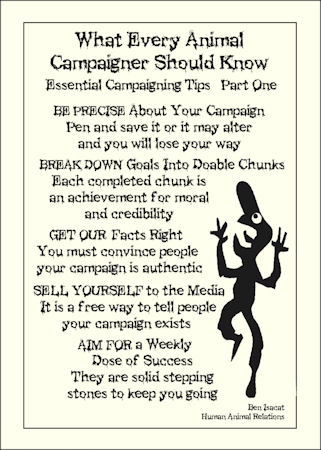
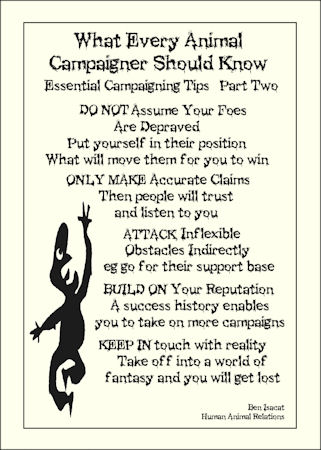
These are just some fields of interest in animal rights and you can come up with others, among them animal abuse and its relationship with human abuse, caged hens and open rescue, cruelty-free shopping, and xenotransplantation. If you are still stumped for an objective to campaign for then contact organisations that take your interest and may want to set up a group in your district. Ten Essential Campaigning Tips Here are pointers for success that are common to most campaigns and every campaigner should know from the start. 1. What Is Your Campaign? What are you ultimately trying to achieve? If you are not completely clear about what you are aiming for you are not likely to achieve it. Your ultimate aim must be clear and precise. A good exercise is to write down your ultimate goal in less than a dozen or so words. You need to record your goal anyway and keep it safe so that over time it does not insidiously change, for it could change into something that seems the same yet in effect is really different. The route to your original goal may not be the same as the route to your changed goal so that you just go round in circles. 2. Break Down Goals Into Manageable Chunks Break down your ultimate goal into small chunks you know you can attain. To shut down an animal abusing pet shop or aquarium (ultimate goal), your sub-goals could be: (1) Itemise how the shop may respond to your attack and how you will counter each response. (2) Complete a file of facts that supports your case on the shop. (3) Convince people in the shop's neighbourhood about your cause and document their support. (4) Lobby and win over your local political representative to support your case (see Chapter 3: Lobbying). And so on... Completing each sub-goal will give you a sense of achievement, keep the momentum going, be good for moral, boost your credibility and bring you closer to your ultimate goal. 3. Is It Outrageous? Outrage is what the news media thrive on and what the public love to read. Issues that may make you fume but for which nothing can be done, or for which everything possible is being done, are not outrages in this sense. An outrage has to be something that nothing or little is being done about yet a great deal can be done about it. Make the focal point of your campaign an outrage and you are more likely to succeed. People who hear about an outrage may turn into fellow campaigners or support you in some other way. 4. Do Sufficient Research You must convince people generally and policy makers in particular that your campaign issue is important. So get as many relevant and accurate facts that you can about your issue from different perspectives: background, some quantitative figures, the major players, relevant legislation and government policy. Write it in a simple form that people can understand easily. Issues often generate conflict between people because people get their facts wrong or are biased. The more you know, the more expert you will become and people will have more confidence in you. For a regional issue you could get information by carrying out a local survey. For a wider issue a web search might bring up lots of information. Go for reputable, authoritative, primary sources, that is first hand evidence, not what someone says someone else has said. 5. Know Who You Must Influence Once you know exactly what you are going to campaign on, work out who you need to influence and whose support you need to win. Influencing and winning over 'the public' is too vague. Does your issue involve the people in your locality or region, an institution, a local or national authority, a senator or member of parliament - perhaps a combination? How are you going to reach them? (See Lobbying, Chapter 3.) 6. Your Resources Do not worry about money - good actions do not necessarily have big budgets, if any budget at all. However, start campaigning with something within your reach. Do members of your group have complementary abilities and experience? Is anyone good at organising events, speaking in public, handling the news media or have expertise in web design? (See Chapter 3: Starting a Group.) If you do not have what you need and cannot get it, think up another campaign. 7. Alternative Viewpoints No matter how you see your issue, how do the people you must influence see it? Examine the forces, people and organisations at work for and against the change you want to bring about. See things from their points of view. You want to save a wood for its animal inhabitants and need to persuade your local authority not to bulldoze it. You might think the wood is important for frogs, owls and weasels, but the local authority see it as a resource for a recreation park and timber. So emphasise the issue in their terms - dog walking and renewable wood felling - and they will be more likely to listen to you. 8. Broaden Your Public Your campaign is more likely to succeed the greater the number of people who support you. So find a part of your issue that most people can identify with. You are campaigning against the building of a new abattoir. Most people tolerate killing animals for food but few willingly endure bad smells. You should therefore concentrate your campaign on the issue of odours rather than on vegetarianism. Better to campaign on five per cent of the problem and get 95 per cent support from the people. 9. Join a Coalition Individual groups joining together to work toward the same goal make a coalition. By joining a coalition your group may be able to do more than by working alone. You can snap a single stick but you cannot break a bundle of sticks. Look for other groups and ask what they are doing. Introduce your group to them and give them an idea of the benefits your group can offer them. 10. Can't Get No... You might think that you need hope and passion to change things or that you should have fun and an agreeable time while campaigning. These are important, but what you really need is a measure of satisfaction. Aim for a dose of satisfaction, that is a measure of having achieved something, at least weekly, or daily if possible. You can best get it by setting yourself small goals and achieving them, eg completing a newsletter, bagging a new member, assembling all the bric-a-brac for a fundraising drive. These are solid stepping stones on the way to success that should raise your spirit and keep you going.
More Tips
|
Free Illustrations
|
||||||||||||||||||||||||||||||||||||||||||||||