How to Do Animal Rights - And Win the War on Animals

Your free book to
action animal rights


Grrafix for Animal Lib
Grr! Graphics for Animal Liberation

How to Do Animal Rights -
And Win the War on Animals


Contents

About

Chapter 1
Introduction to Doing Animal Rights


1. The Broad Setting

2. Mass Extinction

3. The Animal Holocaust

How to Do Animal Rights - & Win the War on Animals

Chapter 2
Know Your Animal Ethics & Animal Rights


1. Animal Ethics
Background
Ethics
Importance of Animal Ethics
Glossary
Now a Biff From History
How to Proceed?
Ethical Theories
Ethical Theories Compared
Choosing an Ethical Theory
Do Philosophical Ideas Work?

2. Animal Rights
What are Animal Rights?
Background to Animal Rights
Major Dates for Rights
Animal Rights Theory
Fundamental Animal Ethical Positions
Variations on Animal Rights
Are Rights a Cure-all?
Universal Declaration on Animals
Arguments For & Against Animal Rights

3. Comparing Animal Philosophies
Animal Ethics vs Animal Rights
Animal Rights vs Animal Welfare
Animal Rights vs Conservation
Deep Ecology
Conclusion

How to Do Animal Rights - & Win the War on AnimalsHow to Do Animal Rights - & Win the War on AnimalsHow to Do Animal Rights - & Win the War on Animals

Chapter 3
Campaigning Methods for Animal Rights


1. Introduction

2. Campaigning
Where to Begin?
Keeping Going
Ten Essential Campaigning Tips
More Tips

3. Civil Disobedience
What Is Civil Disobedience
Civil Disobedience & Animal Rights
Arguments For & Against Civil Disobedience

4. Direct Action
What is Direct Action?
Examples of Animal Rights Direct Action
Individual vs Mass Direct Action
Sea Shepherd Conservation Society
Stop Huntingdon Animal Cruelty
The Battle of Brightlingsea
Inset: Background to Brightlingsea
Comparing Direct Actions
Direct Action vs Civil Disobedience
Efficacy of Direct Action

5. Action Planning
What is an Action Plan?
Why an Action Plan?
Who Should Produce the Action Plan?
Before You Begin
Distinguish Operations From Administrations
Creating Your Action Plan
You Should Be Smart
You Should Also SWOT
Make It Happen
Review It
A Simple Action Plan Template

6. Lobbying
Who Can Lobby?
What & Whom to Lobby
Start Lobbying
How to Lobby
Lobbying Techniques

7. Picketing
What is Picketing?
AR Picketing is Like Industrial Picketing
How to Picket

8. Starting a Group
What to Do?
Name & Logo
Finding Members
A Constitution?
The Group Committee
Group Success Or Failure
Newsletters
Fundraising

9. Publicity

10. Leafleting
Design
Printing
Distribution
Posters & Placards
Other Media

11.News Media
Media Tips
A Feature Article?
The Letters Page
News Release
The Radio
Radio Tips

12. Internet
The Web
Email
Create Your Own Web Site
Designing Your Web Site
Capturing Viewers
Discussion Boards

How to Do Animal Rights - & Win the War on Animals

Chapter 4
Activities for Animal Rights


 1. Undercover Investigator

 2. Video Activist

 3. Animal Friendly Traveller

 4. Preacher

 5. Animal Rescuer

 6. Investigative Reporter

 7. Media Watcher

 8. Philosopher

 9. Flyer

10. Personal Activist

11. Animal Lawyer

12. Politician

13. Prisoner Supporter

14. Public & School Speaker

15. Aerial Snooper

16. Scientific Investigator

17. Solo Information Worker

18. Street Theatre Actor

19. Teacher

20. Voluntary Worker Abroad

How to Do Animal Rights - & Win the War on Animals

Chapter 5
The Law & Animal Rights


1. Terrorism
Background
Terrorism Defined
Animal Extremism & Terrorism
Does AR Extremism Work in Practice?

2. Violence or Nonviolence?
Can We Justify Violence?
Kinds of Violence
Views For & Against Violence
Is Violence Efficacious?
Conclusion

3. The Law - US & Britain
United States
FBI vs Extremists
Britain
Extremist Tactics
Establishment Fights Back

4. Police Arrest
In the Street & At Your Door
At the Police Station
Your Tactics
Know Your Rights
Remaining Silent
Your Lawyer
Suing the Police

How to Do Animal Rights - & Win the War on Animals

Chapter 6
Assorted Animal Rights Activists


1.  Steven Best

2.  John Lawrence

3.  Andrew Linzey

4.  Richard Martin

5.  The McLibel Two

6.  Ingrid Newkirk

7.  Jill Phipps

8.  Henry Salt

9.  Henry Spira

10. Peter Singer

11. Tom Regan

12. Richard D Ryder

How to Do Animal Rights - & Win the War on Animals

Chapter 7
Animal Numbers Raised & Killed


1.  Summary

2.  Chickens

3.  Pigs

4.  Beef Cattle

5.  Fish

6.  Meat Consumption

7.  Fur-bearers

8.  Experimental Animals

How to Do Animal Rights - & Win the War on Animals

Chapter 8.  Extras!

1.  Mutilations of Farm Animals

2.  The Five Freedoms

3.  Painism

4.  The Forgotten Fur

5.  The Golden Rule

6.  Human Overpopulation

7.  Climate Change

8.  Think Like an Animal


Appendix 1
World Scientists' Warning to Humanity.

Appendix 2
Universal Declaration on Animal Welfare.


Italiano


English


How to Do Animal Rights -
And Win the War on Animals


Chapter 1


Introduction to Doing Animal Rights


1. The Broad Setting

Prepare for Doom! "More than any other time in history, mankind faces a crossroads. One path leads to despair and utter hopelessness. The other, to total extinction. Let us pray we have the wisdom to choose correctly." Woody Allen (1)


The Big Problem

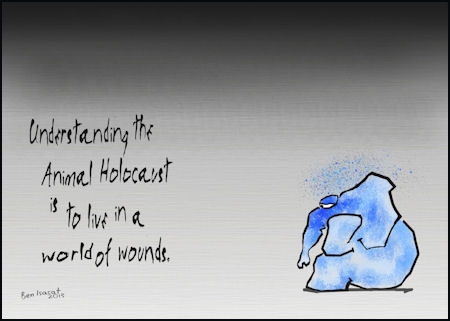
Humans have been killing animals for millennia and now scientists acknowledge that we are living in a mass extinction of life caused by humanity (2). Added to this is an animal holocaust in which increasing numbers of people endlessly demand animals to eat, wear, kill for sport, experiment on, and more. In almost anyone's definition this is a man made disaster - a war on animals - undeclared and devastatingly carried out. This war on animals shouts for action. Animals need allies and making active allies for animals is what this online book is about.

Being Active

To be active for animal rights all you need to be is an ordinary person. You do not have to be an 'animal rights terrorist' (see Chapter 5), the stereotype bogeyman of the news media. The media's animal rights archetype is a rare creature because for every bogey animal rights terrorist there is a multitude of concerned people from all walks of life doing their bit for animals. You, too, whether city financier, unemployed anarchist or domestic granny, can make your contribution and be a real ally of animals.

The Best Animal Rights Attitude

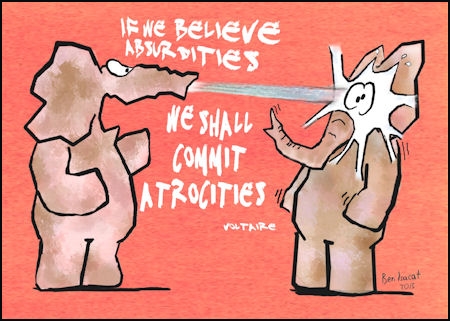
As an animal rights activist your attitudes and values will inevitably clash with those of other people. This is where you have to determine what your beliefs are based on. Confused beliefs, inaccurate views and misconceptions fill our minds. The distinguished French writer Francois-Marie Arouet (1694 - 1778), popularly known as Voltaire, is credited with saying, "If we believe absurdities, we shall commit atrocities." (3) One of the most disturbing visions in the history of human progress is the spectre of the early vivisectors nailing live animals onto dissection boards to cut them open at leisure and see how they worked...before the era of anaesthetics. The vivisectors conveniently believed that animals do not feel pain even though animals behave as though they do.

So what is our best attitude for being active for animals? Surely it is always to question what we know, try to understand what we do not know and keep a healthy scepticism about what people tell us. Having the right attitude demands that we constantly question our beliefs, especially when we think we are right, and never be complacent (for more see Chapter 2). This is especially important when we consider the moral place of animals.

The Expanding Circle

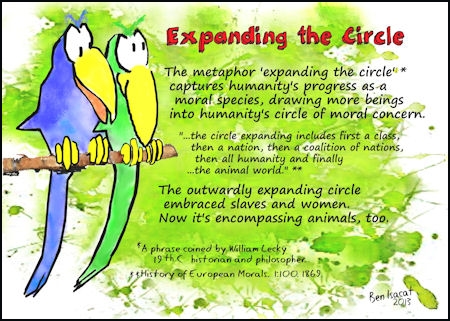
Expanding the circle is an evocative metaphor that captures the progress of humanity as a moral species. It is a phrase coined by the Irish historian and philosopher William Lecky (1838 - 1903) and means that humanity is enfolding more beings in its group as worthy of respect and moral consideration. Lecky writes:
"At one time the benevolent affections embrace merely the family, soon the circle expanding includes first a class, then nation, then a coalition of nations, then all humanity and finally, its influence is felt in the dealings of man with the animal world..." (4)
Lecky's statue stands neglected outside the University of Dublin as his reputation gathers dust. Yet the moral circle is expanding. Only a few generations ago slaves were excluded from the core of human society and women were marginalised. Slavery and domestic servitude were accepted as social norms.

So how close are we to accepting animals within the expanding circle? It is apt that the distinguished animal liberation philosopher Peter Singer (see Chapter 6) invoked Lecky's metaphor as the title of his book The Expanding Circle. (5) Singer reasons that indeed the human moral circle is beginning to embrace animals, confirmed by the existence of the numerous and growing number of people fighting for animal lib. Nevertheless, even with Singer's optimism and energy we still have a long way to journey toward the day when humanity finally accepts animals within its moral circle.

The Great Leap

A good reason for allying ourselves with animals and including them in our moral circle is for their sake. Looking beyond that, another good reason is humanity is about to make a great leap into the future. Blasting off into space, deciphering genomes and implanting synthetic parts in our bodies are some of the signs of this impending leap. They signal that we are saying good-bye to our organic roots based on natural selection and are entering a new phase of evolution based on science and technology. We are shaping a transformation of humanity into a super-being that will be unrecognisable to present generations (assuming humanity and science survive the next hundred years). However, we must not allow our future-being to ravage every creature it meets for its own ends, in the present style of humanity. We must instil in it an enlightened and compassionate morality to be a powerful force for good in the universe. To this end we must labour to expand our circle of moral consideration to encompass all creatures, whatever and wherever they are.

References

(1) Allen, Woody. My Speech to the Graduates. In Complete Prose. Picador: London. 1997.

(2) Leakey, Richard & Lewin, Roger. The Sixth Extinction: biodiversity and its survival. Weidenfield and Nicolson: London. 1996.

(3) Possibly paraphrased from a speech in 1767.

(4) Lecky, William Edward Hartpole. History of European Morals From Augustus to Charlemagne. 1869:100–101. Vol 1.

(5) Singer, Peter. The Expanding Circle: ethics and sociobiology. Clarendon Press: Oxford. 1981.
 
How to Do Animal Rights -
And Win the War on Animals.
First published on the Web: April 2008.
© Roger (Ben) Panaman, April 2008. All rights reserved.